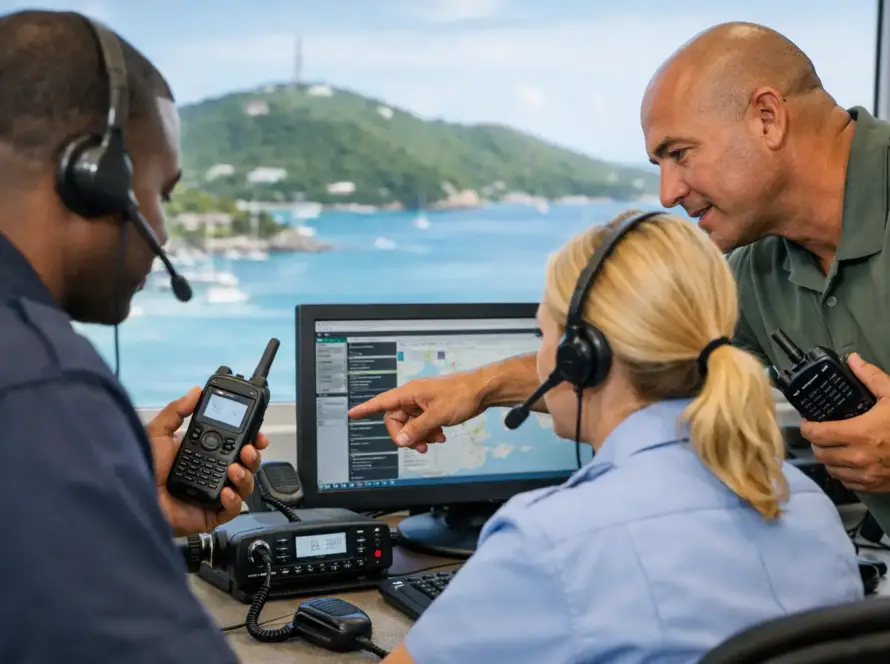
When a public works crew is dispatched after a storm, or a port unit needs direct coordination with field personnel across mixed terrain, communication failure is not a minor inconvenience. It slows response, creates safety risks, and leaves agencies working around technology instead of relying on it. That is why radio communications services for government have to be planned as operational infrastructure, not treated as a one-time equipment purchase.
For government agencies in the U.S. Virgin Islands, that distinction matters even more. Island geography, dense structures, coastal exposure, weather events, and interagency coordination all place real demands on radio performance. A system that looks adequate on paper can still fall short in the field if coverage, interoperability, maintenance, and lifecycle support were not addressed from the start.
What government agencies actually need from radio systems
Government communications requirements are usually broader than basic push-to-talk. Agencies need dependable voice service, but they also need a system that fits how teams move, where they operate, and what happens when normal conditions change.
A parks department, emergency management office, public works division, port authority, or utilities team may all use radios differently. Some require wide-area mobile coverage for vehicle fleets. Others need reliable in-building performance, compact handhelds for field inspections, or cross-agency coordination during incidents. The right answer depends on mission, geography, staffing patterns, and risk tolerance.
That is where many procurement efforts go wrong. Buyers focus on the radio unit itself instead of the full communications environment. Devices matter, but they are only one part of the system. Coverage design, repeater placement, power resilience, programming, encryption options, user training, repair support, and future expansion all affect whether the system actually performs when it is needed.
Why radio communications services for government are more than equipment
A serious provider of radio communications services for government should approach the work as a service lifecycle. Agencies rarely benefit from a simple box sale. They benefit from assessment, design, implementation, support, and maintenance aligned to agency operations.
The first stage is understanding use cases. Who needs to talk to whom? Across what distance? In what terrain? Under what conditions? Is the system supporting daily operations, incident response, or both? Will users be on land, near the waterfront, in vehicles, inside reinforced facilities, or moving between islands? These are not technical side questions. They determine system architecture.
The next stage is selecting the right platform. In some cases, a conventional analog solution may still make sense for budget-conscious users with straightforward coverage needs. In others, DMR offers stronger efficiency, clearer audio, better channel use, and features that support larger operations. Push-to-Talk over Cellular can extend communications reach when agencies need broader coverage, flexible deployment, or integration with mobile data environments. Each option has advantages, and each has limits.
Analog remains familiar and can be practical, but it may not offer the control, scalability, or spectrum efficiency needed by growing agencies. DMR supports more advanced management and can improve performance in demanding operational settings, but it requires proper planning and programming. PoC can be a strong fit where cellular availability is acceptable and fast deployment matters, but agencies should evaluate network dependency and continuity planning before treating it as a full replacement for every radio function.
Coverage is where success or failure usually shows up
For government users, coverage gaps are not abstract technical flaws. They appear as missed calls, delayed coordination, and field teams improvising around dead spots. In the Virgin Islands, terrain and construction patterns can make those gaps more likely if systems are not engineered with local conditions in mind.
Hills, shoreline transitions, dense buildings, concrete structures, and separated operational zones all affect propagation. A radio may perform well in one district and struggle in another. Portable coverage can differ from mobile coverage. Outdoor performance may not match in-building performance. That is why radio planning should be based on real operating areas, not assumptions borrowed from another market.
Government agencies also need to think beyond normal-day coverage. A system should be evaluated for disrupted conditions, backup power considerations, site hardening, and recovery support. If an agency depends on communications during storms, utility interruptions, or high-traffic incidents, resilience becomes part of the design standard.
Interoperability matters, but so does control
Public-sector communications often involve more than one department. Even when agencies operate separate systems, there are times when they need to coordinate directly. That could include public works and emergency management, transportation and port operations, facilities and security, or municipal and territorial functions working together during a response.
Interoperability is essential, but it should not come at the cost of operational control. Agencies still need talk group structure, user permissions, disciplined programming, and clear communication procedures. A system that lets everyone talk to everyone all the time may sound efficient, but in practice it can create channel congestion and confusion.
The better approach is structured interoperability. That means designing communications paths that support coordination when needed, while preserving day-to-day channel discipline. It also means documenting templates, naming conventions, and escalation procedures so radio use stays organized under pressure.
Security and administration are part of mission readiness
Government buyers are right to ask about encryption, device management, and system access. Field communications are operational assets, and poor radio administration creates avoidable risk.
Security in radio environments is not only about whether a system supports encrypted traffic. It also includes who can program devices, how lost radios are handled, whether user access is segmented properly, and how fleets are maintained over time. An agency with inconsistent codeplug management, outdated configurations, or undocumented changes can create its own reliability problems.
Administrative discipline matters just as much as technical capability. Agencies need standardized fleet management, controlled updates, and service records that show how the system is maintained. This becomes especially important as radio systems intersect more closely with IP networks, dispatch tools, and broader communications infrastructure.
Maintenance is not optional after deployment
One of the most common mistakes in public-sector communications is assuming the project is finished once the radios are handed out and the repeater is online. In reality, deployment is the start of the operational phase.
Batteries degrade. Antennas are damaged. Users transfer roles. Coverage expectations change. A new facility goes into service. A storm event affects a site. Firmware needs review. Accessories wear out. If there is no maintenance plan behind the system, performance usually declines quietly until it becomes a visible problem.
This is why support capability should be weighed as heavily as product specifications. Agencies need a provider that can handle repair, programming, testing, replacement planning, and ongoing technical support without long delays. Local field awareness also matters. A provider familiar with island conditions can usually diagnose practical issues faster than a distant vendor working from generic assumptions.
For agencies across Saint Thomas, Saint John, and Saint Croix, service continuity often depends on having a communications partner that understands both the equipment and the operating environment. That is where a company such as Cwave Communications can bring practical value, especially when government teams need radio expertise tied to local infrastructure realities.
How to evaluate radio communications services for government
The best procurement questions are usually operational, not promotional. Ask how the provider assesses coverage. Ask what support exists after installation. Ask how fleet programming is controlled, how repairs are handled, and what options exist for growth, backup, and interoperability.
It is also worth asking what the provider sees as the trade-offs between DMR, analog, and PoC for your specific mission. A credible partner should not force every agency toward the same answer. They should explain where each option fits, where it does not, and what assumptions must hold true for the system to perform well.
Government leaders should also evaluate whether the provider can support adjacent infrastructure needs. Radio systems do not exist in isolation anymore. Network design, wireless connectivity, cybersecurity, and communications continuity planning increasingly overlap. A provider that understands those relationships can reduce fragmentation and help agencies make better long-term decisions.
The strongest radio systems are not always the most complex. They are the ones built around actual field use, maintained with discipline, and supported by people who understand what failure would cost. For government agencies, that is the standard worth buying against.