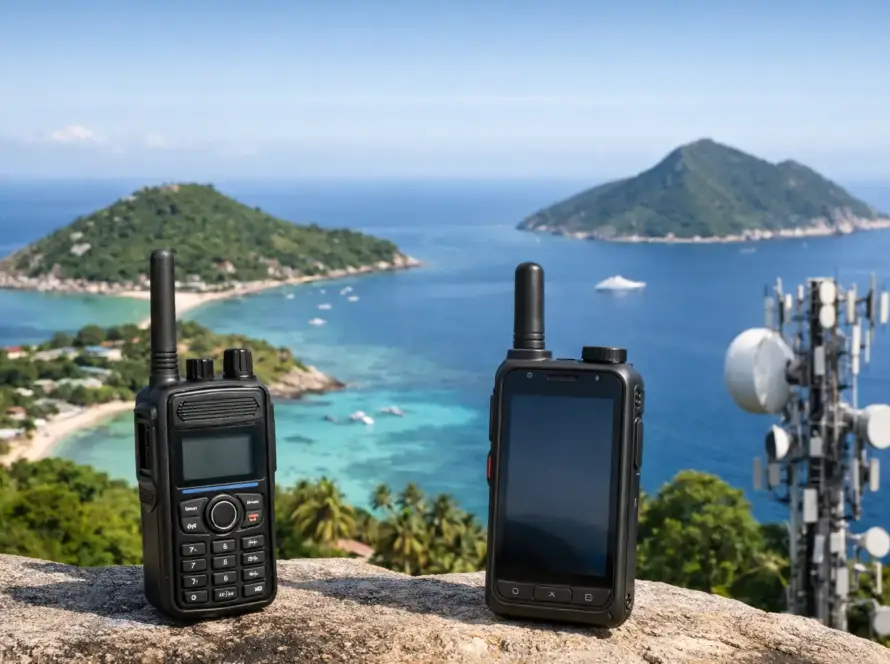
A remote team can be ten miles offshore, on the far side of Saint Croix, or split between a control room, a service vehicle, and a dock. In those situations, wireless communications solutions for remote teams are not a convenience item. They are part of daily operations, safety planning, and response time.
For organizations in the U.S. Virgin Islands, the challenge is not simply how to let people talk. The real question is how to maintain reliable communication across water, hills, mixed infrastructure, severe weather exposure, and job sites where cellular performance may vary. That is where solution design matters. The right system depends on who needs to communicate, where they work, how critical the traffic is, and what happens when a message does not get through.
What remote teams actually need from a communications system
Most buyers begin by asking about devices. In practice, the first issue is operational continuity. A field supervisor, marine crew, utility technician, security team, or public-sector department needs communication that stays available during routine work and under pressure.
That usually means four things at once: dependable coverage, clear audio, manageable equipment, and support after deployment. If a system performs well in a showroom but fails in hilly terrain or between islands, it is the wrong system. If it works well on day one but no one maintains batteries, repeaters, accessories, or user programming, performance will decline fast.
Remote teams also need the right balance between immediacy and flexibility. Some operations require instant push-to-talk with no dialing and minimal delay. Others need broader reach through cellular and IP-based networks. Some teams need both. That is why the best wireless communications solutions for remote teams are rarely one-size-fits-all.
Wireless communications solutions for remote teams by environment
The environment drives the architecture. A marina, hotel campus, construction site, utility corridor, vessel fleet, or government field operation may all be considered remote, but the communications profile is different in each case.
Push-to-Talk over Cellular for broad-area coordination
Push-to-Talk over Cellular, or PoC, is often a strong fit when teams are spread across large service areas and need simple group communication over existing cellular data networks. For managers overseeing multiple crews across Saint Thomas, Saint John, and Saint Croix, PoC can provide wide-area reach without the footprint of a traditional radio network at every site.
Its strength is flexibility. Users can communicate across islands, between vehicles and offices, and with supervisors who are not physically on location. Dispatching can also be more centralized. For commercial operations, transportation teams, hospitality support staff, and organizations with mobile personnel, that can improve coordination quickly.
The trade-off is network dependency. If cellular coverage is weak in a specific area, if a structure blocks service, or if a storm affects network performance, PoC can be limited. It is a strong tool, but not always the only tool.
DMR radio for controlled coverage and operational reliability
Digital Mobile Radio, or DMR, is often the better answer when coverage control, voice clarity, and network independence matter more than broad cellular reach. A properly designed DMR system can support campuses, industrial sites, utility operations, marine support environments, and field teams that require dedicated radio performance.
DMR is especially valuable where organizations need predictable talk groups, efficient channel use, and better audio performance than older analog-only deployments. It can also support scalable infrastructure, from a single-site operation to a wider linked system, depending on geography and requirements.
The trade-off is infrastructure planning. DMR performs best when repeaters, site placement, antenna systems, and programming are engineered for the actual terrain. That takes more planning than handing out off-the-shelf devices, but the result is a communications platform built for operations rather than convenience.
Analog radio where simplicity still wins
Analog radio remains relevant in some remote team environments. If a site has a straightforward coverage area, legacy equipment, and limited complexity, analog can still be practical. It is familiar, direct, and in some cases cost-effective for smaller teams.
That said, analog is not always the right long-term answer. As fleets grow and communication demands become more complex, limitations around audio quality, feature depth, and scalability can become more noticeable. For some organizations, analog makes sense as a stable baseline. For others, it is better viewed as a transition stage.
How to choose between PoC, DMR, and mixed systems
The wrong way to choose is by asking which technology is best in general. The right way is to ask which one fits the mission.
If your teams work across a wide footprint and need communication between mobile users, supervisors, and offices with minimal infrastructure at each site, PoC may be the strongest fit. If your team operates in areas where dedicated radio coverage is essential, DMR may offer stronger control and reliability. If you have older equipment and a simple operating footprint, analog may remain serviceable for now.
In many cases, mixed environments make the most sense. A marine operator may rely on maritime radio for vessel traffic, use land mobile radio for on-site coordination, and add PoC for management communication across islands. A field services company may use DMR for crews in coverage-challenged work zones and PoC for managers moving between locations. The goal is not to force one platform everywhere. The goal is to build a system that reflects how the organization actually operates.
Coverage is the real test
For remote teams, coverage claims mean very little until they are tested against local conditions. The U.S. Virgin Islands present real variables: elevation changes, coastal interference, structural density, vegetation, open water, and the distance between operational points.
This is why site assessment and system design are not optional extras. They are central to performance. A communications plan should account for where users stand, travel, dock, stage equipment, and respond after hours. Indoor and outdoor coverage may differ sharply. A vessel route may perform differently than a hilltop work site. A system that sounds fine at the office may break down in the exact place where field personnel need it most.
Reliable remote communications start with mapping operational reality, not relying on assumptions.
Security, maintenance, and lifecycle support matter more than buyers expect
Many organizations focus on deployment and underestimate sustainment. That is a costly mistake. Radios, repeaters, antennas, dispatch tools, batteries, and accessories all require ongoing attention if the system is expected to remain mission-ready.
Programming drift, battery degradation, damaged accessories, and neglected infrastructure can erode performance quietly. The same is true on the network side. If wireless systems interface with broader IP environments, security practices matter. Device access, management controls, and network segmentation may become part of the conversation depending on the deployment.
This is where a service-driven approach has an advantage. A provider that handles consulting, installation, repair, maintenance, and long-term support brings more value than one that simply sells hardware. For remote teams, uptime is not created by equipment alone. It comes from planning, implementation, and disciplined support over time.
What decision-makers should look for in a provider
The strongest communications partner will ask detailed questions before recommending equipment. They will want to understand geography, user roles, traffic volume, emergency procedures, interoperability needs, and future expansion plans. That level of detail is a good sign.
They should also understand local operating conditions. In the Virgin Islands, communications planning is shaped by island terrain, marine environments, infrastructure variability, and service realities that are difficult to assess from a distance. A provider with practical regional experience is better positioned to design systems that hold up in the field.
Cwave Communications works in that space, supporting organizations that need radio, wireless networking, and communication infrastructure built for actual operating conditions rather than generic assumptions.
Wireless communications solutions for remote teams are an operations decision
Too often, communications purchases get treated as an equipment line item. For remote teams, they should be treated as an operations decision. The system affects response time, staff coordination, safety posture, customer service, and continuity during disruptions.
That is why the best solution is not always the newest device or the broadest feature set. Sometimes the right answer is a dedicated DMR system with carefully planned coverage. Sometimes it is PoC for flexible island-wide coordination. Sometimes it is a mixed platform with clear roles for each layer. The right choice depends on risk, geography, and how work actually gets done.
If your remote teams are carrying communication gaps as part of normal operations, that is usually a sign the system needs to be reevaluated. The right communications design should reduce uncertainty, support the people in the field, and keep the mission moving when conditions are less than ideal.