A DMR radio comparison should start with the work your team must accomplish, not a handset price or feature list. A marina coordinating vessel arrivals, a resort managing maintenance calls, and a public works crew responding across multiple sites may all need two-way radio communications, but their coverage, capacity, safety, and dispatch requirements are different.
For organizations in the U.S. Virgin Islands, those differences are amplified by terrain, building construction, island-to-island distance, weather exposure, and the consequences of a coverage gap. The right DMR system is the one that gives personnel clear, dependable communication where they actually work, while remaining practical to maintain and expand.
What DMR Changes Compared With Analog Radio
Digital Mobile Radio, or DMR, is a digital two-way radio standard used by commercial, industrial, maritime, and public-sector organizations. It improves on a basic analog radio system in several operational areas: voice clarity at the edge of coverage, channel efficiency, privacy options, GPS and text-data capability, and centralized management.
A key advantage is two-slot TDMA technology. In practical terms, one 12.5 kHz radio channel can support two separate voice paths. A business can assign one path to operations and another to security, for example, without obtaining a second channel. This can increase capacity while using spectrum efficiently.
That does not mean digital is automatically better in every circumstance. Analog audio often fades gradually, while digital audio can remain clear until it reaches its usable limit and then drop out more abruptly. System design matters. Radio placement, antenna height, battery condition, programming, and indoor coverage all determine whether users experience DMR as a major improvement or a source of frustration.
DMR also allows many organizations to migrate in stages. Dual-mode radios can operate on analog and digital channels, which helps teams preserve compatibility during a planned transition rather than replacing every device at once.
DMR Radio Comparison: Start With the System Type
The most meaningful DMR radio comparison is usually between system architectures, not simply between individual portable radio models. The correct choice depends on how many users need to talk, how widely they operate, and whether calls must be coordinated through a dispatcher.
Conventional DMR for focused operations
Conventional DMR assigns channels or talkgroups to specific users and functions. It is a strong fit for a single property, facility, port area, worksite, or fleet operating within a defined coverage footprint. A supervisor can call all personnel, while departments retain separate talk paths for daily work.
This approach is generally straightforward to deploy and operate. It works well when radio traffic is moderate, personnel are organized by function, and there is no need for automatic channel assignment across a large network. A properly engineered conventional repeater can provide substantially better local coverage than radio-to-radio communication alone.
The trade-off is scalability. As teams, locations, and call volume increase, manually assigned channels can become congested or difficult to manage. Conventional DMR can be expanded, but organizations with broad coverage and high traffic should evaluate whether a trunked system is more appropriate.
Trunked DMR for larger, busier networks
Trunked DMR pools available channels and assigns an open path when a user initiates a call. This model is designed for organizations with more users, more talkgroups, multiple sites, or significant simultaneous activity. Instead of dedicating a channel to each department, the system uses resources dynamically.
For distributed operations across Saint Thomas, Saint John, or Saint Croix, a multi-site trunked design may support coordinated communications while keeping local teams organized. It can also provide stronger tools for dispatch, priority calls, user management, and system monitoring.
The benefit is operational control and capacity. The cost is greater planning, infrastructure, licensing coordination, and ongoing system administration. A trunked network should be designed around real traffic patterns and coverage objectives, not purchased solely because it has more features.
Direct mode and repeater coverage
Every DMR evaluation should separate direct mode from repeater-backed communication. Direct mode allows radios to communicate radio-to-radio without infrastructure. It is useful for close-range work, temporary teams, and continuity if a repeater is unavailable.
A repeater receives and retransmits radio signals from an elevated or strategically located site, extending useful coverage. In hilly terrain or reinforced buildings, the difference can be decisive. A portable radio may work across a dock in direct mode but fail from the waterfront to an office, warehouse, hillside road, or lower level of a concrete structure.
Coverage should be validated through a site survey and field testing. Coverage maps are useful planning tools, but they are not a substitute for testing in the stairwells, mechanical rooms, parking areas, waterfront spaces, and routes where employees actually operate.
Compare Radios by the Conditions They Must Survive
Once the system architecture is established, selecting portable and mobile radios becomes more focused. The best device is not always the one with the longest specification sheet. It is the one users can carry, hear, operate, and recharge consistently in their work environment.
Audio performance deserves close attention. Restaurants, construction areas, vessel engine rooms, roadways, and crowded event spaces all create noise that can defeat an otherwise capable radio. Look at speaker output, noise suppression, microphone placement, and accessory options. A remote speaker microphone or approved earpiece may be more valuable to a team than additional menu features.
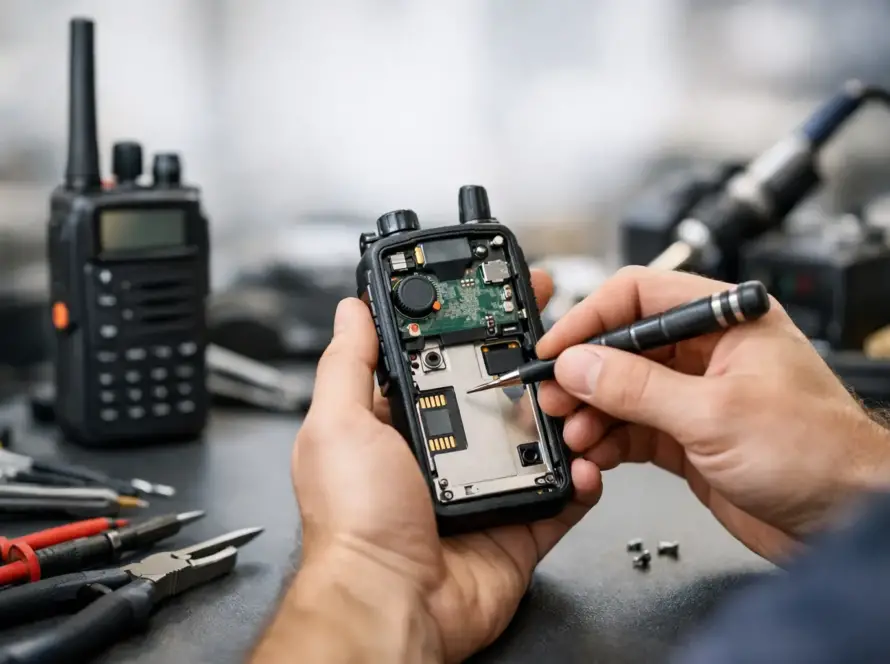
Durability should match exposure. For outdoor crews and maritime-adjacent operations, water and dust resistance, corrosion-aware accessories, secure battery latches, and reliable charging practices matter. A radio rated for tough conditions still needs inspection, cleaning, and correct accessory management to perform over time.
Battery planning is equally operational. A stated battery-life figure may assume a limited transmit duty cycle and moderate temperature. Long shifts, frequent calls, GPS reporting, high audio volume, and weak-signal areas can reduce runtime. Organizations that depend on radios throughout a full shift should plan for spare batteries, multi-unit charging, and a documented battery replacement cycle.
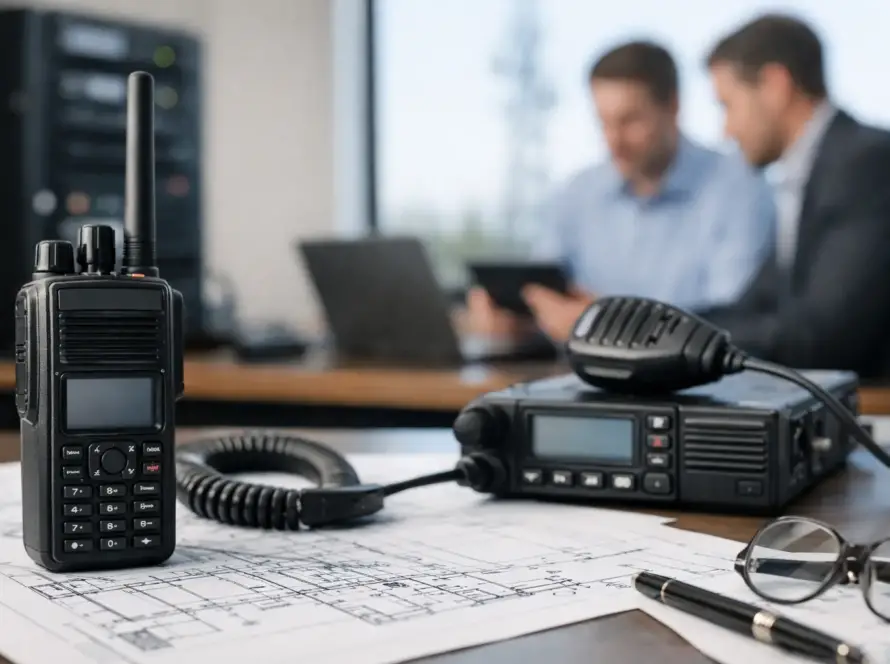
Mobile radios installed in vehicles, vessels, and fixed dispatch locations also deserve separate evaluation. Their higher transmit power and external antennas can strengthen coverage, but installation quality is critical. Antenna location, cable routing, grounding, power protection, and marine environmental conditions all affect performance.
Features That Matter Only When They Support a Workflow
DMR can support features such as individual calling, emergency alerts, GPS location, text messaging, call recording through dispatch applications, remote monitor functions, and lone-worker alerts. These capabilities can improve safety and accountability, but only when the organization defines who receives an alert and what happens next.
An emergency button is not a safety plan by itself. Teams need a response procedure, escalation path, dispatcher training, and regular tests. GPS can help locate vehicles or personnel, but its value depends on update intervals, coverage, privacy policy, and the ability of supervisors to act on the information.
For many operations, the highest-value features are simpler: clear group calls, reliable emergency signaling, assigned talkgroups, disciplined radio etiquette, and a dispatch view that makes active operations easier to coordinate.
DMR, PoC, and Cellular: Choose the Right Coverage Tool
DMR and Push-to-Talk over Cellular, or PoC, solve different problems. DMR uses licensed radio spectrum and local radio infrastructure. It can continue operating independently of commercial cellular service when designed with appropriate power and backhaul resilience. It is often the preferred foundation for a contained site, local fleet, critical facility, or environment where immediate group communication is essential.
PoC uses cellular and Wi-Fi networks to provide wide-area communication. It can be highly useful for organizations with personnel traveling between islands, working across dispersed locations, or requiring communication beyond the footprint of a local radio network. It also offers a practical path for users who need nationwide connectivity without deploying repeaters at every location.
Some organizations benefit from both. DMR serves the on-site operational layer, while PoC connects management, mobile supervisors, and remote teams. The decision should follow coverage needs and continuity requirements, not a one-technology-for-everything assumption.
Plan for Support Before Purchasing Equipment
A radio system is a long-term operational asset. Programming changes, damaged accessories, battery replacement, repeater maintenance, coverage adjustments, and user training are normal parts of ownership. The ability to receive local support can matter as much as the initial equipment selection.
Before moving forward, decision-makers should confirm four practical points:
- Where must communications work, including weak-signal and indoor areas?
- How many simultaneous conversations are expected during normal and peak activity?
- What happens if commercial power, internet service, or a key site becomes unavailable?
- Who will manage programming, repairs, testing, and user training after deployment?
Cwave Communications, an authorized Hytera dealer, can help organizations translate those questions into a field-ready design, from radio selection and coverage planning to installation, maintenance, and lifecycle support.
The most effective DMR system is rarely the most complex one. It is the system your people trust when operations become busy, conditions become difficult, and a clear call needs to get through the first time.