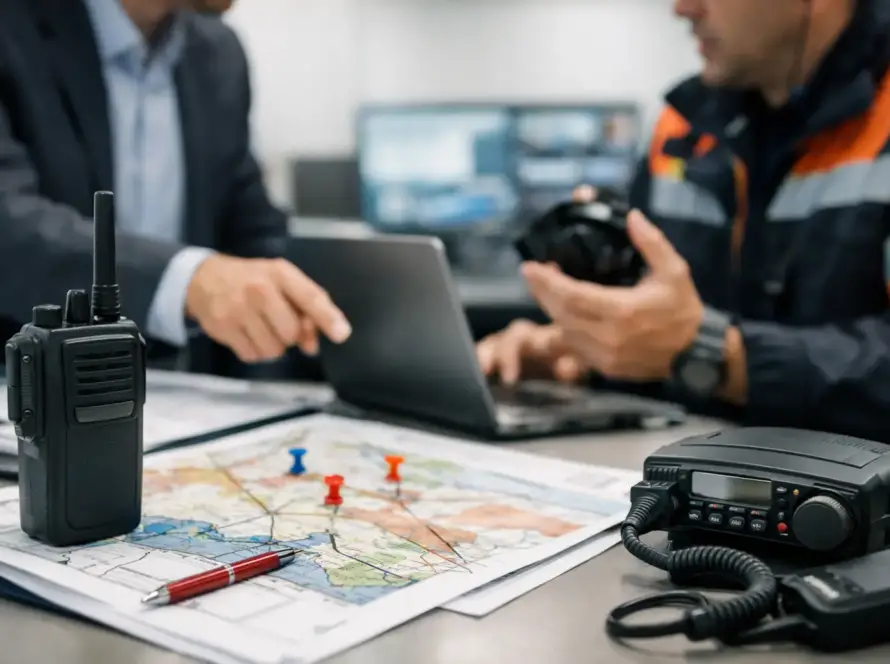
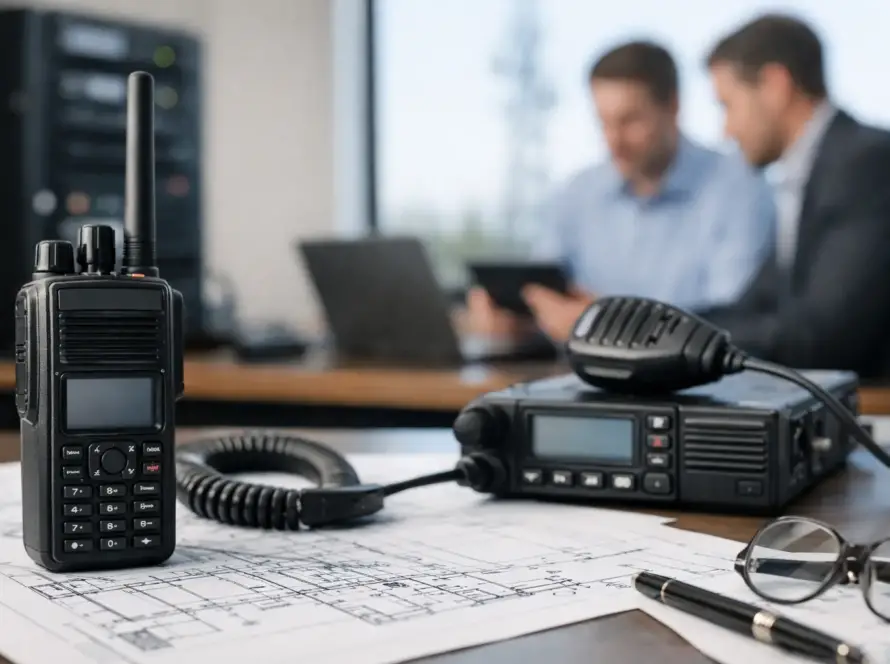
A radio that works at the dock but drops out behind a hillside, inside a concrete building, or on the far side of an island is not a communications plan. When evaluating DMR vs PoC coverage, the right answer depends less on the handset in a catalog and more on where teams actually work, what infrastructure is available, and how much interruption the operation can tolerate.
For organizations in the U.S. Virgin Islands, coverage planning has to account for steep terrain, water crossings, dense structures, remote work locations, power conditions, and variable cellular service. DMR and Push-to-Talk over Cellular can both provide dependable group communications, but they achieve coverage in fundamentally different ways.
DMR vs PoC Coverage: The Core Difference
Digital Mobile Radio, or DMR, uses licensed radio frequencies and a purpose-built radio network. Coverage comes from direct radio-to-radio communication, installed repeaters, antenna systems, and properly engineered backhaul where needed. A well-designed DMR system gives an organization control over its communications footprint.
Push-to-Talk over Cellular, or PoC, uses commercial cellular data networks and, where supported, Wi-Fi. A user can press the talk button in Saint Thomas and speak to a team member in Saint Croix, on the mainland, or anywhere else with approved network access. The practical coverage area can be very large, but it follows the availability and performance of the underlying cellular or Wi-Fi connection.
That distinction changes the planning question. With DMR, ask: “Where can we place infrastructure to create the coverage we need?” With PoC, ask: “Where do our users have usable carrier data or Wi-Fi, and what happens when they do not?”
Neither approach is automatically better. A resort maintenance team operating primarily on one property may get excellent results from a local DMR system. A logistics company coordinating personnel between islands, vehicles, offices, and off-island partners may gain more value from PoC. Many serious operations use both.
How DMR Coverage Is Built
DMR coverage begins with radio frequency design. Portable radios communicate over a limited range when operating directly with one another. Terrain, building materials, antenna position, transmit power, vegetation, and weather conditions can all affect that range. Direct mode can be useful for close-range work and as a contingency, but it should not be mistaken for island-wide coverage.
Repeaters extend the system by receiving and retransmitting signals from an elevated, carefully selected site. Depending on the operation, a DMR design may use one repeater for a defined facility, multiple linked repeaters for a larger service area, or additional in-building equipment for difficult structures.
On hilly islands, antenna elevation and line of sight are often decisive. A location with a clear view toward a harbor, road corridor, or work zone can serve users well, while a valley or a structure behind a ridge may need a different solution. A coverage map is useful, but it is only a starting point. Field testing with the actual radios, at the actual work locations, identifies the dead zones that matter operationally.
DMR also provides an advantage when public cellular service is weak, congested, or unavailable. If the repeater, power supply, antennas, and network components are properly maintained, users can communicate within the designed coverage area without depending on a commercial mobile data connection. That local independence is valuable for utilities, marine operations, facilities teams, and public-sector users with continuity requirements.
There are trade-offs. A DMR system requires frequency coordination and licensing, equipment installation, site access, power protection, ongoing maintenance, and engineering. Coverage does not expand automatically beyond the network design. Extending communications to another island, distant facility, or remote user may require additional infrastructure or an IP-connected system architecture.
DMR is strongest when local control matters
DMR is often the better fit when teams need predictable coverage in a defined area, particularly where cellular gaps are known. It is also well suited to users who need a dedicated talk path, clear audio, emergency functions, and a system that remains useful during a local data-network interruption.
The key qualifier is “defined area.” A single radio repeater cannot overcome every ridge, concrete wall, or sheltered bay. Reliable DMR coverage is designed, measured, and maintained, not assumed.
How PoC Coverage Works in the Field
PoC turns a cellular-connected device into a wide-area push-to-talk radio. The device may be a purpose-built Hytera PoC radio, a mobile unit in a vehicle, or another approved form factor. It connects to a managed PTT platform through LTE, 5G, or Wi-Fi, enabling individual calls, groups, priority communications, location features, and centralized administration.
Its greatest advantage is reach. If each user has working data coverage, a dispatch office can communicate with drivers, managers, contractors, and field personnel across separate islands without building a radio repeater network at every location. For distributed organizations, this can reduce the complexity of connecting sites and make it easier to add new users.
However, PoC coverage is not the same as cellular signal bars. A device may show service yet have insufficient data quality for dependable real-time voice. Congestion, indoor signal loss, network outages, roaming limitations, damaged infrastructure, and oversubscribed Wi-Fi can all affect performance. Coverage must be validated for the carrier, device, application, and locations that matter to the organization.
PoC also depends on how the device is configured and supported. Managed user groups, priority rules, device security, charging practices, SIM management, and platform administration all influence whether the system is ready when a team needs it. It is a communications service, not simply an app installed on a phone.
PoC is strongest when the team is geographically distributed
PoC is often the practical choice for organizations with personnel traveling between Saint Croix, Saint Thomas, Saint John, ports, offices, warehouses, customer locations, and off-island destinations. It gives supervisors one communications environment without requiring every user to be inside the footprint of a local radio repeater.
It is especially effective where carrier coverage is consistently strong and where the operational value of wide-area communications outweighs dependence on commercial network availability. For some organizations, that is the majority of daily work.
Coverage Questions That Should Drive the Decision
The most useful assessment starts with actual operating conditions, not a preference for a particular technology. Map where users begin and end their shifts, where incidents occur, which buildings create signal loss, where vehicles travel, and which areas lack dependable cellular service.
Then define the consequence of a missed call. A delayed housekeeping request and an interrupted port-security coordination call do not carry the same operational risk. Teams that require immediate communications during outages, severe weather, remote work, or emergency response may need a locally controlled DMR layer even if PoC serves their routine communications well.
Consider these four factors together:
- Coverage footprint: Is the operation concentrated on one site or spread across islands and distant locations?
- Infrastructure dependency: Can the operation rely on commercial cellular and Wi-Fi, or does it need independent radio coverage at critical locations?
- Building and terrain conditions: Are there concrete structures, hillside shadows, interior rooms, marine areas, or valleys that need targeted testing?
- Continuity requirements: What communications method remains available when carrier service, internet access, or utility power is disrupted?
Budget also matters, but it should be evaluated over the life of the system. PoC may reduce upfront infrastructure costs for a distributed workforce. DMR can require more initial engineering and site equipment, yet it may provide long-term operational control in high-priority areas. The lower initial purchase price is not always the lower operational cost.
The Hybrid Approach Often Delivers Better Coverage
For many island organizations, DMR versus PoC is not an either-or decision. A hybrid design uses each technology where it performs best. DMR can cover a campus, marine terminal, industrial site, or remote facility where local reliability is essential. PoC can connect supervisors, drivers, management, and inter-island personnel over a wider area.
This approach also supports practical redundancy. If carrier data is unavailable at a critical site, local teams can continue using DMR within the radio system’s coverage area. When personnel leave that area, PoC can keep the broader organization connected where cellular service is available. The systems do not have to replace one another to create value.
The design still needs discipline. Users must understand which device or channel to use, dispatch procedures must be clear, and coverage expectations must be documented. Adding technologies without an operating plan can create confusion rather than resilience.
Start With a Coverage Assessment, Not a Device Choice
The right communications system starts with a site and workflow assessment. Test representative locations, including indoor areas, road routes, docks, hilltop sites, parking areas, and places where teams work after hours. Review existing carrier performance and identify where a DMR repeater, external antenna, in-building enhancement, backup power, or secondary communications method is justified.
Cwave Communications, an authorized Hytera dealer, can help organizations evaluate these conditions before selecting a DMR, PoC, or combined deployment. The goal is not to sell more equipment than required. It is to establish communications coverage that matches the work, the geography, and the consequences of failure.
A dependable system is one your team has tested where the work actually happens. Build around those locations first, then choose the technology that keeps the conversation going.