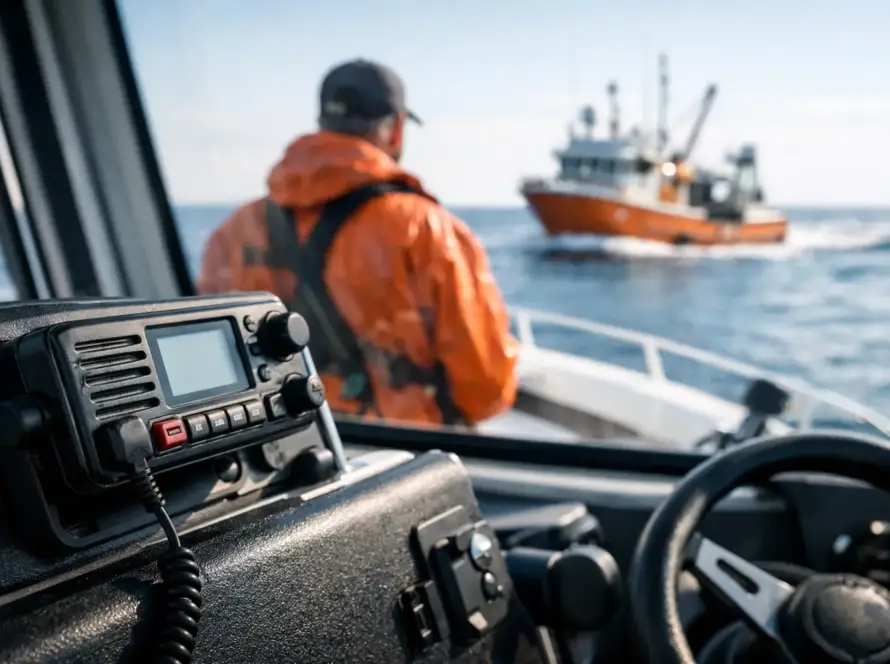
A repeater that works perfectly on a bench can still leave crews without coverage behind a ridge, inside a concrete facility, or on the far side of a harbor. This Hytera repeater deployment guide focuses on the decisions that determine real operational performance: coverage objectives, site conditions, RF design, power protection, and support after commissioning. For organizations in the U.S. Virgin Islands, those decisions must account for steep terrain, salt exposure, variable utility conditions, and communications that may be needed when normal infrastructure is under pressure.
Start With the Operational Requirement
Do not begin by selecting a repeater model. Begin by defining what the system must accomplish and where it must work. A marina may need reliable dock-to-vessel coordination and coverage through waterfront buildings. A facilities team may need communication from a central office to generators, remote sites, and maintenance crews. Public-sector and utility operations may need coverage that remains available during an extended power or backhaul outage.
Document the users, talk groups or channels, operating areas, indoor locations, and the type of traffic expected. Voice-only operations have different needs than systems carrying text, GPS location, telemetry, or dispatch data. The required number of simultaneous conversations also matters. A single conventional DMR repeater can be an efficient answer for a smaller team, while multiple repeaters, linked sites, or a more structured system may be appropriate as traffic and coverage requirements grow.
Define the acceptable failure point as well. If a repeater site loses commercial power, how long must communications continue? If the primary network connection fails, should local radio communications remain available? These are operational requirements, not accessories to be considered later.
Hytera Repeater Deployment Guide: Build the Coverage Plan First
Coverage is shaped by terrain, antenna height, frequency band, building construction, antenna system losses, and local noise. A high site can be valuable, but height alone does not guarantee usable portable-radio coverage. Signal paths may be blocked by hillsides, reinforced concrete, metal roofing, or dense equipment areas. A site that serves one side of Saint Thomas well, for example, may have significant shadows in another valley.
A proper plan starts with a coverage objective rather than a coverage promise. Identify the areas where handheld radios must work, the areas where mobile radios are acceptable, and any locations where communications are safety-critical. Field testing is especially valuable before finalizing a site. Prediction tools inform the design, but walk and drive tests reveal actual noise floors, building penetration issues, and terrain shadows.
The antenna system deserves the same attention as the repeater itself. Feedline type and length, connectors, grounding, lightning protection, duplexers, combiners, and antenna placement all affect performance. Losses between the repeater and antenna can erase much of the advantage gained by choosing higher-power equipment. Conversely, a well-engineered antenna system can improve coverage without creating unnecessary interference.
Frequency coordination and FCC licensing should be addressed early. The selected channels, bandwidth, emission designators, and operating authority must align with the intended system. A deployment should also consider adjacent-channel activity and the possibility of intermodulation at shared or RF-dense sites. These details protect both system performance and regulatory compliance.
Choose a Site That Can Stay On the Air
The best coverage site is not always the best operational site. A repeater location must be accessible for installation and service, physically secure, environmentally suitable, and supported by dependable power. It also needs enough space for radio equipment, batteries, surge protection, network hardware, and orderly cable management.
In coastal environments, salt air changes the maintenance equation. Outdoor-rated enclosures, sealed cable entries, corrosion-resistant hardware, appropriate grounding, and scheduled inspections are practical requirements. Moisture intrusion in a connector or feedline may begin as a minor signal issue and become a complete service interruption during poor weather.
Power planning should be based on measured load, not estimates alone. Include the repeater, DC power supply, battery charger, network equipment, cooling, and any accessories in the calculation. Battery backup can bridge short utility interruptions, while a generator-supported design may be necessary for longer outages. The appropriate duration depends on the mission. A commercial operation may accept several hours of standby power; an essential service may require a longer, tested backup strategy.
Network-connected systems also need a clear backhaul plan. Where IP connectivity supports linking, dispatch, monitoring, or remote management, assess bandwidth, latency, reliability, and cybersecurity controls. Local radio service should be designed to continue in the manner required by the operation if the WAN connection is unavailable.
Configure for the Way Teams Actually Work
A repeater deployment is successful only when the radio configuration matches the work. Channel names should be clear, talk groups should reflect actual coordination needs, and emergency features should be configured deliberately rather than enabled by default. Too many channels can slow users down. Too few can force unrelated teams to share traffic and create avoidable congestion.
For DMR systems, decisions around timeslot use, color code, admit criteria, transmit interrupt, roaming, and group structure should be documented. These settings influence capacity, user experience, and interoperability. Analog compatibility may also be necessary when an organization is transitioning from legacy equipment or must communicate with outside partners using authorized channels.
Program a controlled template for each role or department, then test it with the people who will use it. A dispatcher, security officer, maintenance technician, and vessel operator may not need the same channel order or feature access. Keeping templates disciplined makes future updates and replacements faster while reducing configuration errors.
Security should be proportional to the operation. Authentication, access control, encryption where authorized and appropriate, protected management interfaces, and secure network segmentation can reduce exposure. Security controls should support availability, not make emergency use unnecessarily difficult.
Commission With Measurable Tests
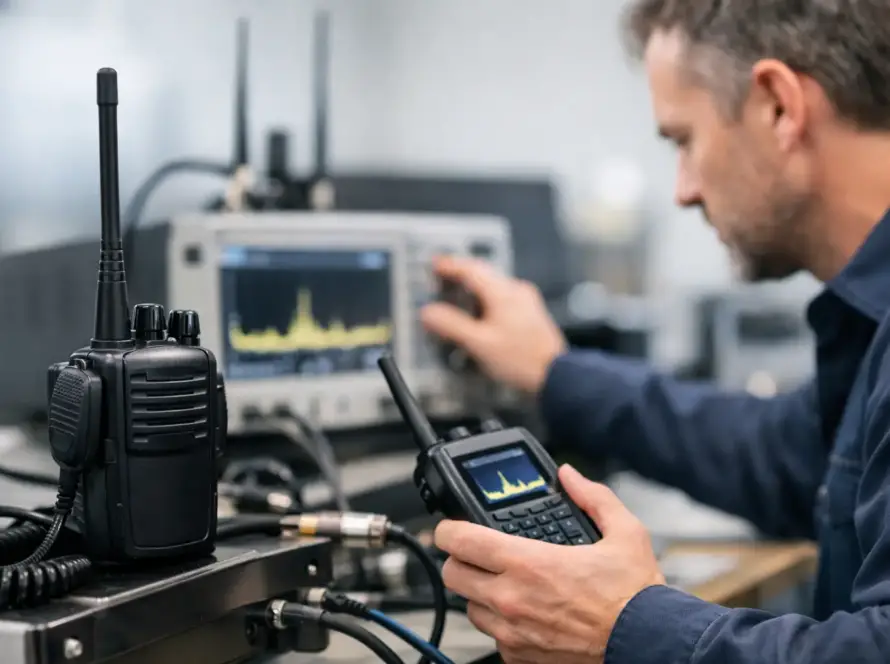
Installation is not commissioning. Before the system enters service, verify the repeater, antenna path, power system, alarms, and user radios as an integrated system. Record transmit power, receive sensitivity, standing wave ratio, battery condition, site grounding, and network status where applicable. Baseline measurements make later troubleshooting far more efficient.
Coverage acceptance testing should follow the locations and scenarios established in the original requirements. Test handheld radios at the edge of expected coverage, in key buildings, and in known difficult areas. Test mobiles while moving through normal routes. Confirm audio quality, access reliability, emergency procedures, and the behavior of any linked or dispatch functions.
Do not overlook failure testing. A controlled commercial-power interruption verifies that batteries and transfer arrangements perform as designed. A network outage test can confirm whether local communications continue correctly. Testing these conditions at commissioning is safer and less costly than discovering gaps during an actual event.
Provide practical user training at launch. Teams should know how to select the right channel, place an emergency call if their system uses that feature, care for batteries, report coverage issues, and use radio discipline. Clear, concise procedures often improve system performance as much as a technical adjustment.
Maintain the System as Critical Infrastructure
Repeaters are long-life assets when they are inspected and maintained. They are not install-and-forget equipment. Schedule periodic site visits to inspect antennas, feedlines, grounding, batteries, environmental conditions, alarms, and signs of corrosion. Review coverage complaints for patterns. A recurring issue in the same area may indicate a site change, new RF interference, a damaged antenna component, or a growing operational need.
Keep current records for frequency authorization, radio templates, equipment serial numbers, site drawings, test results, and service history. These records shorten restoration time when equipment is replaced or a storm affects multiple sites. Spare batteries, critical connectors, and appropriate replacement radios can also make a meaningful difference when supply access is delayed.
Cwave Communications, an authorized Hytera Dealer, can help organizations translate coverage goals into a field-ready deployment and lifecycle support plan. The value is not simply placing equipment at a high point. It is building a communications system that can be tested, maintained, and relied upon by the people doing the work.
The right deployment leaves your team with more than stronger signal bars. It gives them a known communications path, a support plan, and the confidence to keep operations moving when conditions are less than ideal.