A marine VHF radio review should answer a practical question before it compares features: will this radio let your crew call for help, coordinate work, and receive critical information when conditions are poor? For operators in the U.S. Virgin Islands, that question carries extra weight. Open water passages, island terrain, changing weather, and trips between ports can expose the limits of a poorly selected or poorly installed radio.
The right VHF is not necessarily the one with the longest feature list. It is the one that fits the vessel, the operating area, the crew’s habits, and the communications plan behind it. A quality radio is only part of the system. Antenna height, cable condition, GPS position data, correct programming, and crew familiarity all affect real-world performance.
Marine VHF Radio Review: Start With the Vessel
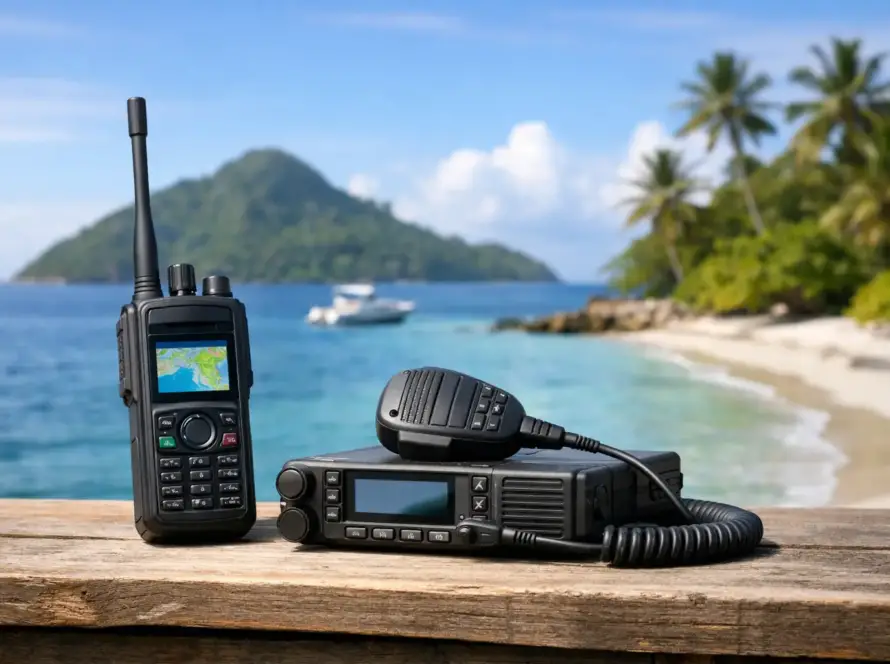
Most boats benefit from a fixed-mount VHF as their primary radio. A fixed unit is connected to the vessel’s electrical system and a dedicated external antenna. That antenna can be mounted high above the waterline, which matters because VHF performance is largely line-of-sight. A radio with a high, correctly installed antenna will usually communicate farther and more consistently than a handheld unit at deck level.
For a commercial vessel, charter operation, workboat, or larger recreational boat, a fixed VHF should be treated as core safety equipment. Look for a full-power 25-watt transmitter, Digital Selective Calling capability, a clear display, dedicated emergency controls, and an interface that can accept GPS data. These are operational requirements, not luxury upgrades.
Handheld marine VHFs have a different job. They are valuable as a backup to the fixed radio, a tender radio, or a portable option for crew working away from the helm. Their lower antenna height and typically lower transmit power limit range, particularly around island terrain or in rough conditions. A handheld should strengthen the communications plan, not replace a properly installed fixed unit on a vessel that operates offshore or carries passengers.
A practical equipment review should assess the radio in its intended setting. A compact center-console with occasional coastal use may prioritize a waterproof handheld backup and a straightforward fixed radio. A vessel making regular inter-island runs needs a more deliberate installation, reliable GPS integration, a capable antenna system, and a defined inspection schedule.
DSC and GPS Are Core Safety Functions
Digital Selective Calling, commonly called DSC, lets a radio send a digital distress alert with the vessel’s identity and position when configured correctly. Pressing the protected distress button can transmit an emergency alert on the designated digital calling channel, giving responding stations information that a voice call alone may not provide.
That benefit depends on setup. The radio needs a valid Maritime Mobile Service Identity, or MMSI, programmed into it. It also needs accurate position data from an internal GPS receiver or a connected external GPS source. A DSC radio without position information is still better than no DSC, but it does not deliver its full value during an emergency.
During a marine VHF radio review, confirm how GPS is handled. Some radios have built-in receivers that reduce installation complexity. Others rely on a chartplotter or external navigation source. Either approach can work, provided the connection is secure and the position shown on the radio is checked regularly. On a working vessel, make this a pre-departure verification, not an assumption.
DSC also supports direct vessel-to-vessel calling when both parties have MMSI numbers. That can reduce unnecessary traffic on voice channels. However, crews still need to understand normal voice procedures, distress calls, urgency calls, and the proper use of monitoring channels. Technology improves the alerting process; it does not eliminate the need for disciplined radio practice.
AIS Reception Helps, but It Is Not a Substitute
Many fixed marine radios now include an Automatic Identification System receiver. AIS can display identifying and position information from nearby transmitting vessels, helping operators build awareness in traffic areas, near harbors, and during reduced visibility.
An AIS receive function is useful, but it does not mean the vessel is transmitting its own AIS position. Receiving and transmitting are separate capabilities. It also does not replace radar, visual lookout, navigation judgment, or direct radio contact when another vessel’s intentions are unclear.
For operations where traffic coordination is routine, an AIS-enabled radio can be a sensible addition when paired with a compatible chartplotter or display. The decision should be based on how the vessel is operated. A simple radio that crew members use confidently may be more effective than a feature-heavy unit whose functions are never configured.
Do Not Judge Range by Transmit Power Alone
A common mistake is assuming that two 25-watt fixed radios will provide the same usable range. The radio is only one part of the signal path. Antenna placement, antenna gain, coaxial cable quality, connector condition, and nearby obstructions often matter more than small differences between radio models.
VHF signals are generally limited by the horizon. Raising the antenna can improve the distance at which two stations can hear each other. That is why a vessel with a well-installed antenna at the top of a mast, hardtop, or elevated mount may outperform a unit with impressive specifications but a low or compromised antenna installation.
Cable deserves special attention in saltwater service. Corrosion, water intrusion, crushed coax, and loose connectors weaken a system gradually. The radio may still power on and receive nearby traffic, creating a false sense of readiness, while transmitted signals travel far less effectively than expected. Periodic antenna and cable testing should be part of vessel maintenance.
Evaluate the Controls Under Pressure
A radio should be easy to operate with wet hands, vibration, glare, engine noise, and limited attention. Small details have a direct impact on safety. The volume and squelch controls should be intuitive. Channel changes should be quick. The emergency button should be protected from accidental activation but accessible when needed. The speaker must remain understandable at the helm.
Water-resistance ratings are also worth reviewing, especially for open boats and exposed helm stations. A rating describes resistance under defined test conditions, not permanent immunity to salt spray, sun exposure, or repeated immersion. A protected mounting location, cover where appropriate, and regular rinsing and inspection remain necessary.
Battery performance is central for handheld units. Assess the stated operating time realistically, with the screen lit, GPS active, and occasional transmission. A rechargeable battery pack is convenient, but a backup charging method or spare power source can be just as important. A portable radio that is stored uncharged is not a backup.
A Field-Ready Selection Checklist
Before choosing a radio, evaluate these operational points:
- Primary use: emergency communications, harbor coordination, passenger operations, tender work, or offshore travel.
- Installation plan: antenna location, cable route, power connection, grounding requirements, and GPS source.
- Safety functions: DSC capability, programmed MMSI, tested position display, and accessible distress controls.
- Crew use: readable controls, understandable audio, radio procedure training, and a documented channel plan.
- Support plan: installation quality, periodic inspection, repair access, and replacement battery availability for handhelds.
This review process is more useful than comparing specifications in isolation. It identifies the gaps that can affect communications when a crew needs the radio most.
Installation and Support Determine Long-Term Value
Marine electronics operate in a demanding environment. Heat, vibration, salt, moisture, and intermittent power create failure points that may not appear during a dockside test. Professional installation helps protect the investment by addressing power routing, fusing, antenna placement, cable terminations, GPS integration, and equipment mounting from the start.
For fleets and organizations operating across Saint Thomas, Saint John, and Saint Croix, standardizing radio setups can simplify training and maintenance. Crews know where key functions are located, managers can document MMSI and installation details consistently, and service personnel can diagnose problems faster. Cwave Communications can support this kind of practical communications planning with local maritime radio expertise and ongoing service.
Keep the radio check simple and repeatable. Confirm that the unit powers on, the correct channels are monitored, the GPS position is current, the antenna system is intact, and the handheld backup is charged. Then make sure the people aboard know what to say and which function to use. A well-chosen marine VHF earns its value not when it is installed, but when it delivers a clear call at the moment it is needed.