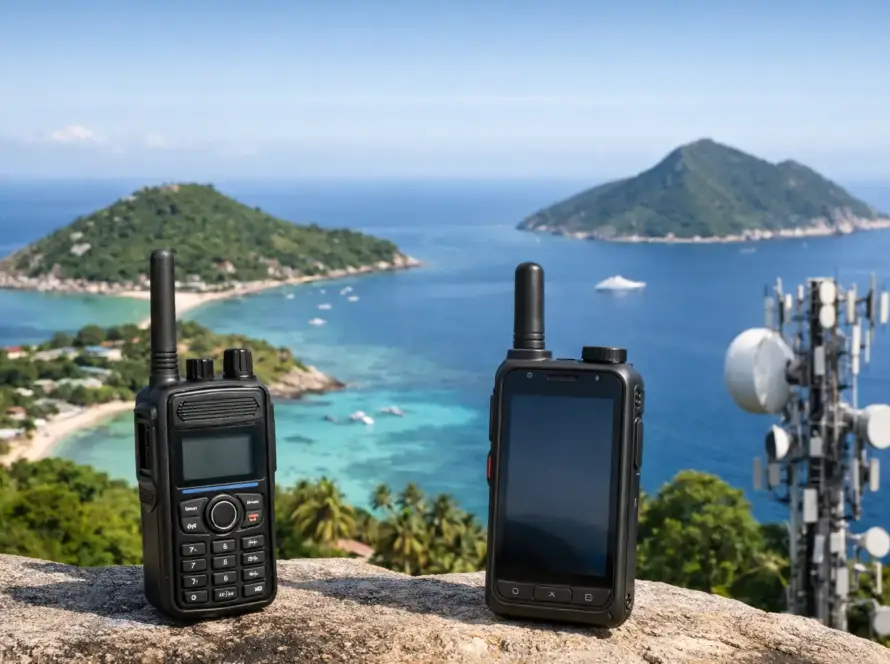
When a field team misses a call on a busy worksite, the problem usually is not the radio in someone’s hand. It is the system choice behind it. That is why the dmr vs analog radios question matters so much for operations leaders, facility managers, marine users, and public service teams that cannot afford confusion, weak coverage, or avoidable downtime.
For many organizations, both technologies can work. The better choice depends on how your teams operate, how much traffic your channels carry, what level of audio quality you need, and how much support you want over the life of the system. DMR is not automatically the right answer for everyone, and analog is not outdated just because it has been around longer. Each has a place.
DMR vs analog radios at a glance
Analog radios transmit voice in a continuous signal. They are familiar, straightforward, and often easier to integrate into older radio fleets. If your team needs basic push-to-talk voice communications over a smaller area with limited channel demand, analog may still be enough.
DMR, or Digital Mobile Radio, converts voice into digital data before transmission. That change affects more than sound quality. It can improve channel efficiency, support features such as text messaging and GPS, and provide stronger audio performance at the edge of usable coverage. For organizations managing multiple crews, vehicles, facilities, or island-wide activity, those gains can be meaningful.
The practical question is not which one is newer. It is which one supports your daily operations with fewer communication failures.
Audio clarity and usable coverage
This is usually the first difference users notice. Analog audio tends to degrade gradually. As signal strength drops, voices become noisier, weaker, and harder to understand. Many teams are used to that behavior and can work around it, but there is a point where repeated callouts and missed instructions start slowing down the job.
DMR behaves differently. Within its working range, audio is typically cleaner and more consistent. Users often hear clear voice transmissions where analog would already sound rough. At the edge of coverage, though, digital audio can drop off more abruptly. Instead of fading into static, the transmission may become broken or stop being intelligible all at once.
That trade-off matters in the real world. If your teams operate across buildings, hills, waterfronts, and mixed terrain, better voice intelligibility can improve coordination. But system design matters just as much as radio type. A poorly planned DMR system will still disappoint. A well-built analog system can still be very effective.
Channel capacity and team coordination
If your organization has only a handful of users on a few channels, analog may be perfectly manageable. If several departments are sharing traffic, handling dispatch, or coordinating mobile teams, analog can start to feel crowded quickly.
DMR is more efficient with spectrum. One major advantage is that it can support two voice paths on a single 12.5 kHz channel using time slots. In practical terms, that can give you more communication capacity without doubling your licensed frequencies. For operations with maintenance teams, drivers, supervisors, and site personnel all working at once, that added efficiency can reduce congestion and improve response times.
This is one reason DMR often makes sense for growing organizations. You are not only buying radios. You are building room for operational growth.
Features beyond basic voice
The dmr vs analog radios decision often comes down to whether you need more than voice.
Analog systems can handle core push-to-talk communication reliably. For many users, that is enough. But DMR supports a broader feature set that can improve visibility and control. Depending on the system and programming, you may have capabilities such as unit IDs, private calling, GPS location, text messaging, emergency alerts, remote monitoring, and better dispatch integration.
For a manager responsible for fleet coordination, utilities support, property operations, or marine communications, those features are not just nice additions. They can help reduce response delays, improve accountability, and support safety procedures.
That said, extra features only matter if people use them. If your workforce needs a simple radio with minimal training and little menu navigation, a basic analog setup may actually serve the operation better than a feature-heavy digital fleet.
Cost: upfront price versus long-term value
Cost deserves a realistic look. Analog systems are often less expensive to deploy if you already have compatible infrastructure or a small number of users. The radios can be simpler, and the learning curve is usually lighter.
DMR may require a higher initial investment, especially if you are upgrading repeaters, replacing older radios, or redesigning coverage. For some buyers, that is enough to pause the project.
But purchase price is only part of the equation. If DMR reduces channel crowding, cuts down repeated transmissions, supports better fleet management, and gives you a clearer upgrade path, it may deliver stronger long-term value. The right comparison is not radio price against radio price. It is operational performance over several years.
For example, if your team loses time every day repeating instructions, switching channels to find space, or dealing with poor intelligibility in fringe areas, that hidden cost adds up fast.
Reliability in demanding environments
In the Caribbean, communications systems do not operate in lab conditions. Salt air, heat, moisture, storm exposure, and uneven infrastructure all put pressure on equipment and coverage planning.
Both analog and DMR radios can be built for harsh environments. The difference is often in how the system is engineered and maintained. Analog is mechanically and operationally familiar, which some organizations prefer because troubleshooting can be straightforward. DMR can provide stronger performance and better diagnostics, but it also benefits from careful programming, network planning, and support.
For island operations, reliability is rarely about the device alone. It comes down to the full system – radios, repeaters, batteries, antennas, programming, service coverage, and preventive maintenance. That is where a well-supported deployment matters more than a spec sheet.
Migration does not have to be all or nothing
One reason some organizations delay digital upgrades is the assumption that every radio and every site must be replaced at once. Often, that is not necessary.
Many fleets move in stages. An organization may keep analog in one part of the operation while adding DMR capability for teams that need higher capacity, better coverage performance, or specific features. This can make budgeting more practical and reduce disruption for staff.
A phased approach also gives decision-makers time to evaluate how users respond. If your crews are comfortable with analog but dispatch or supervisors need better visibility and control, a mixed transition strategy may be the most sensible path.
Which option fits your operation?
If your communications needs are simple, your user count is low, and your existing analog system is dependable, staying with analog may be a sound business decision. There is no benefit in forcing complexity into an operation that does not need it.
If your teams are spread across multiple locations, your channels are busy, or you need features that improve coordination and accountability, DMR is often the stronger fit. It tends to make more sense for organizations planning for growth, tighter operational control, and better communication performance across more demanding workflows.
For many buyers, the answer is not purely technical. It is operational. Ask where communication failures happen now. Are users struggling with audio quality, limited capacity, weak coverage, or lack of visibility? Those pain points usually point toward the right system faster than a feature checklist does.
A communications partner should be able to assess that honestly, not just recommend the newer option. In the U.S. Virgin Islands, where terrain, weather, and infrastructure conditions shape real-world radio performance, that kind of practical evaluation matters. Cwave Communications approaches radio planning that way – around coverage, reliability, and the day-to-day demands of the operation.
The best radio system is the one your team trusts without thinking about it. When every message gets through clearly and on time, the technology stops being the story, and the work can keep moving.