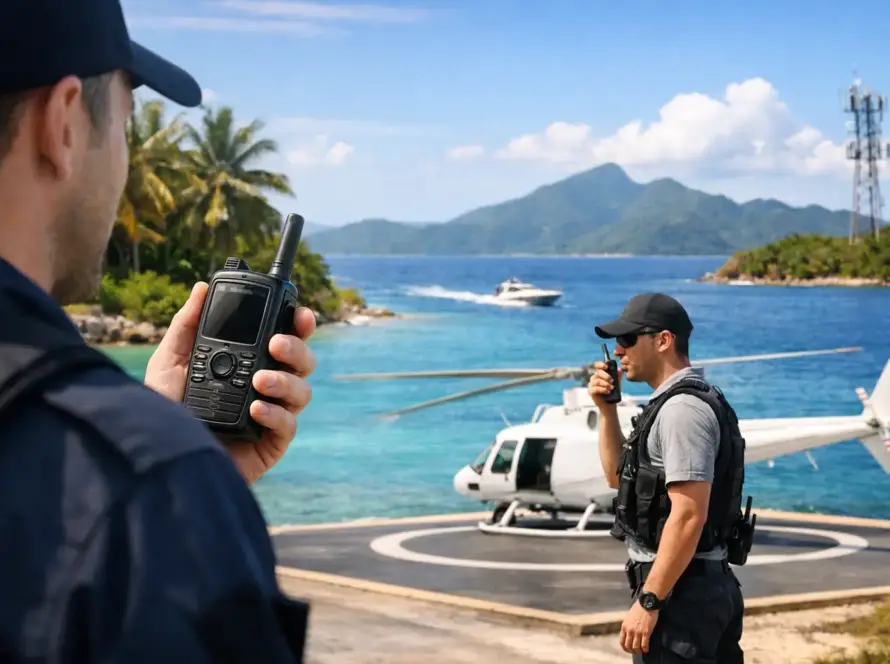
A crew leaving Charlotte Amalie, a facilities team working on Saint Croix, and a field supervisor traveling between job sites do not face the same coverage conditions. That is why the choice between PoC versus satellite communications should start with the work being done, where it is done, and what happens when a call cannot get through.
Both technologies can extend communications beyond the limits of a conventional radio system. They do it in very different ways. Push-to-Talk over Cellular, or PoC, uses available cellular data or Wi-Fi networks to deliver radio-style group communications. Satellite communications connect through orbiting satellites, providing reach where terrestrial networks are unavailable or compromised.
For many organizations in the U.S. Virgin Islands, the strongest answer is not an all-or-nothing decision. It is a communications plan that assigns each technology to the conditions where it performs best.
PoC Versus Satellite Communications: The Core Difference
PoC gives users the familiar experience of a two-way radio while using broadband connectivity. A user presses the push-to-talk button, speaks, and the message is sent through a cellular or Wi-Fi connection to an individual, group, or dispatcher. Because the system is not limited to the range of a local radio repeater, teams can communicate across islands, across the territory, or with authorized personnel elsewhere.
Satellite communications do not depend on local cellular towers, fiber connections, or Wi-Fi. A satellite device communicates with a satellite overhead, making it valuable in remote waters, isolated work areas, and locations affected by a major infrastructure outage. The trade-off is that satellite service generally requires a clear view of the sky, specialized hardware, and an understanding of network capacity and call behavior.
The practical distinction is simple: PoC is usually the more efficient day-to-day tool where cellular or Wi-Fi service is available. Satellite is the continuity tool when terrestrial connectivity is not available or cannot be trusted.
Where PoC Performs Best
PoC is well suited to organizations with personnel spread across multiple sites, vehicles, islands, or service territories. Hotel operations, utilities, security teams, logistics coordinators, construction supervisors, property managers, and public-facing operations can use it to establish talk groups without building a dedicated wide-area radio network for every location.
For operational leaders, the value is not only voice coverage. Depending on the device and service configuration, PoC can support GPS location, emergency alerts, dispatch visibility, messaging, and controlled talk groups. A supervisor on Saint Thomas can coordinate with a team on Saint John while a manager on Saint Croix monitors the same operational channel. That level of coordination is difficult to achieve with a conventional radio system alone unless substantial infrastructure is in place.
PoC also has an advantage in audio workflow. Users typically receive near-instant group communications, and modern purpose-built devices are designed for loud environments, long shifts, and gloved use. The experience remains familiar for teams that already understand radio discipline: listen first, press to talk, speak clearly, and keep traffic brief.
However, PoC coverage is only as dependable as the underlying network. Cellular dead zones, congested service during large events, damaged towers, power failures, and weak indoor signal can all affect performance. A PoC deployment should therefore begin with a realistic coverage assessment, not a coverage map viewed from an office.
PoC is a strong fit when
PoC is generally the right primary platform when teams operate mostly in populated areas, on established roads, at facilities with reliable Wi-Fi, or across multiple locations with usable cellular coverage. It is also a practical option when dispatch, location awareness, and inter-island coordination matter more than off-grid reach.
The key question is not whether cellular coverage exists somewhere on the island. It is whether it exists where employees actually work: lower-level utility rooms, concrete structures, hillside roads, ports, marinas, interior spaces, and the travel routes between sites.
When Satellite Communications Are the Better Choice
Satellite communications become essential when operations take place outside cellular coverage or when the loss of terrestrial infrastructure would create an unacceptable communications gap. Maritime operators are a clear example. Once a vessel moves beyond reliable coastal cellular coverage, satellite can provide a communications path that does not depend on a nearby tower.
Satellite is also appropriate for remote work crews, emergency continuity planning, disaster response staging, and critical facilities that need an independent communications option. In a hurricane-prone region, this independence deserves careful attention. A terrestrial network may recover quickly after a disruption, but recovery timelines vary by location, access conditions, power availability, and damage severity.
Satellite is not automatically the better emergency solution for every user. It has operational constraints. Antennas need an adequate view of the sky, which can be limited by buildings, terrain, dense vegetation, vessel structures, or placement inside a vehicle. Voice quality, transmission delay, data capacity, and equipment cost can also differ from a PoC deployment.
For short, frequent team conversations at a staffed facility, satellite may be unnecessarily expensive and less convenient than PoC. For a vessel operating beyond terrestrial coverage, relying solely on a cellular-based service is a greater risk. The technology should follow the exposure.
Satellite planning requires more than a device
A satellite handset or terminal is only one part of the plan. Teams need to know where it will be stored, who is authorized to use it, how it will be charged, how airtime is managed, and what backup power is available. They also need practice. A device that remains sealed in a cabinet until a communications failure is not a dependable operational asset.
For fixed locations, antenna placement and cable routing deserve professional attention. For marine use, mounting, weather exposure, vessel power, and the expected operating area all affect the right solution. Satellite capability should be tested under normal working conditions, not assumed to work because the equipment is powered on.
Coverage, Resilience, and Cost Must Be Considered Together
The most common mistake in PoC versus satellite communications planning is treating coverage as the only requirement. Coverage matters, but resilience, usability, and cost determine whether a system will serve the organization over time.
PoC often has lower device and service costs for broad daily use, particularly when personnel already work in cellular coverage areas. It can reduce the complexity of connecting dispersed teams and may support centralized administration. Yet its resilience is tied to the availability of carrier networks, local power, backhaul, and compatible devices.
Satellite can provide a separate path from local terrestrial networks, but that independence comes with higher equipment costs, service plans, and operational restrictions. It should be budgeted as continuity infrastructure, not judged solely by how often it is used. A backup system may spend most of its time quiet. Its value is measured by its readiness when normal communications fail.
A practical evaluation should account for four conditions: ordinary daily operations, poor-signal areas, remote or offshore activity, and extended outage scenarios. If one technology does not cover all four conditions, that does not mean it failed. It means the organization may need layered communications.
A Layered Approach Often Delivers the Best Result
Many organizations benefit from using PoC as the primary day-to-day platform and satellite as a backup or remote-area capability. Conventional DMR or analog radio may also have a place for local on-site coverage, direct radio-to-radio communication, or facilities where cellular penetration is inconsistent. Each layer addresses a different failure point.
For example, a marina may use PoC for routine coordination among dock staff, maintenance personnel, and management across several locations. Satellite capability can be assigned to vessels that travel beyond dependable cellular range or held as part of the marina’s continuity plan. A local radio channel can support immediate on-property coordination when personnel are close together. This is not duplication for its own sake. It is a measured response to different operating environments.
The system should remain simple enough that personnel know which device to use and when. Clear talk-group design, naming conventions, charging procedures, escalation protocols, and routine testing are more valuable than adding features no one uses.
Choosing the Right Communications Partner
The right solution begins with an operational assessment: where teams travel, what buildings or terrain affect coverage, what information must be shared, and how long operations can tolerate an outage. Equipment selection comes after those answers, not before.
Cwave Communications, an authorized Hytera dealer, helps organizations evaluate PoC, radio, networking, and continuity requirements as one communications environment. For operations across Saint Thomas, Saint John, and Saint Croix, local knowledge matters because coverage and infrastructure conditions can change significantly within a short distance.
Before committing to PoC or satellite, test the proposed solution at actual work locations, on real routes, and during realistic shifts. The right system is the one your team can use confidently on an ordinary workday and still depend on when conditions are no longer ordinary.