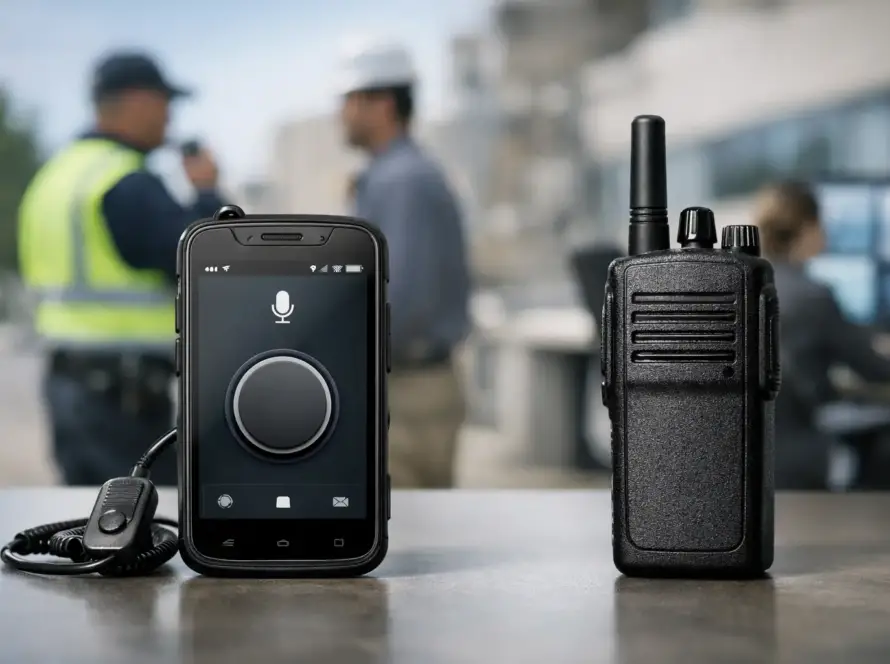
A PoC device review should begin where the work happens, not at a product spec sheet. A radio that sounds clear in an office but drops traffic on a waterfront route, inside a concrete facility, or between islands does not support operations when it counts. For organizations that depend on coordinated crews, fleet visibility, and immediate voice communication, the device is only one part of the system.
Push-to-Talk over Cellular, or PoC, gives teams radio-style communication over available cellular and Wi-Fi networks. It can connect personnel across wide areas without building a dedicated radio network at every location. That is a meaningful advantage for businesses with mobile teams, distributed sites, vehicles, vessels near shore, or staff working across St. Croix, St. Thomas, and St. John. Still, PoC is not automatically the right answer for every user or every coverage area.
Why a PoC Device Review Must Go Beyond the Handset
It is easy to compare screen size, battery capacity, and accessory options. Those details matter, but they do not answer the operational question: can a team communicate clearly and consistently throughout its normal workday?
A useful review considers the entire communication path. That includes carrier coverage, Wi-Fi availability, the PoC platform, group configuration, device management, charging practices, and local technical support. If any link is weak, the end user experiences it as a radio failure.
For example, a supervisor may need one button press to reach a maintenance crew, a delivery team, and a site manager in separate groups. The system must establish the right talk group quickly, deliver understandable audio, and show whether the message was received when confirmation is required. A feature-rich device that requires repeated menus, logins, or workarounds creates friction at the exact moment communication should be simple.
Start With Coverage, Not Features
PoC performance depends on network access. Before selecting a device, map the places where teams actually work: buildings, parking areas, remote roads, ports, warehouses, elevated terrain, and regular travel routes. Ask users where they currently lose calls, rely on personal phones, or leave coverage entirely.
Cellular, Wi-Fi, and Real-World Dead Spots
A device may support multiple carriers, Wi-Fi, Bluetooth, GPS, and advanced calling features. Those capabilities are valuable only when the network plan and deployment design support them. Cellular service can vary significantly around hills, dense structures, coastal areas, and interior workspaces. Wi-Fi can extend service indoors, but poorly designed wireless networks can introduce their own coverage and call-quality problems.
This is where field testing matters. Test candidate devices in the locations and at the times your teams work. Conduct individual calls, group calls, emergency calls, and dispatch communications. Test while walking, riding in a vehicle, using a speaker microphone, and wearing normal work gear. A quick demonstration at a desk is not a deployment test.
For critical operations, identify the areas where PoC has limitations and decide how those areas will be handled. A DMR radio system, analog radio channel, satellite option, or hybrid communications plan may be appropriate where cellular coverage cannot be relied upon. The best design is based on operational requirements, not on forcing every user onto one technology.
What to Evaluate in a PoC Device Review
The right PoC device should make communication easier for the person carrying it. That means evaluating practical use, not just a specification list.
Audio Quality in Noisy Conditions
Clear audio is often the first requirement and the first disappointment when devices are evaluated casually. Test speaker volume and microphone performance near engines, generators, wind, traffic, loading activity, and other common noise sources. Check whether the user can hear a group call without removing the device from a belt clip or pocket.
Noise suppression can improve intelligibility, but it is not magic. It must be tested with the intended accessories and in realistic conditions. A remote speaker microphone may be the better choice for a field crew, while a compact device with a discreet earpiece may suit hospitality, security, or front-of-house operations.
Battery Life and Charging Discipline
A stated battery rating does not always reflect a full operational shift. Screen brightness, GPS reporting, frequent group traffic, weak-signal conditions, and Bluetooth accessories all affect runtime. Evaluate the device after a typical day of use rather than relying only on a laboratory number.
Charging is also a system decision. A fleet of devices needs assigned chargers, spare batteries where supported, vehicle charging for mobile personnel, and a process for identifying units that do not return to service fully charged. A dependable communications plan can be undermined by a device left on a desk at 20 percent battery.
Controls, Durability, and Accessories
The push-to-talk button should be easy to find and operate with gloves, wet hands, or limited attention. Physical controls are particularly useful for workers who cannot safely look at a screen while moving equipment, driving, or managing a task.
Consider the device’s rating for dust, water, drops, and temperature, then compare it to the actual environment. A ruggedized device may cost more up front, but replacing consumer-grade handsets after repeated failures can cost more in downtime and administration. Cases, belt clips, speaker microphones, headsets, and multi-unit chargers deserve the same scrutiny as the device itself. Accessories are often where daily usability is won or lost.
Security and Administrative Control
PoC devices are connected devices. They should be managed accordingly. Organizations should be able to assign users and talk groups, remove access when personnel change roles, apply security settings, and locate or disable a lost device when appropriate.
The right level of control depends on the organization. A small service team may need straightforward group management and basic device tracking. A government department or larger commercial operation may require defined user roles, audit visibility, encryption options, mobile device management, and integration with existing operational processes. Review what the platform can enforce, what requires administrator action, and who will own that responsibility after deployment.
PoC, DMR, or a Hybrid Communications Plan?
PoC is an effective choice when wide-area communication, rapid deployment, GPS visibility, and flexible group calling are priorities. It can reduce the need for separate site-by-site radio infrastructure and can connect teams that work far apart.
DMR is often better suited to sites where direct radio coverage, local independence, and consistent on-premises performance are essential. It does not rely on public cellular service in the same way as PoC. Analog radio may also remain useful for simple local communication or compatibility with existing equipment.
Many organizations benefit from a hybrid approach. A facilities team may use DMR inside a property with challenging indoor coverage while managers and mobile personnel use PoC across multiple locations. A maritime operator may use the appropriate marine radio service for vessel communications while using PoC to coordinate shore-side staff and logistics. The decision should follow the workflow and coverage realities, not a preference for a single device category.
Run a Field Trial Before Committing
A controlled field trial gives decision-makers evidence instead of assumptions. Select a representative set of users: supervisors, field personnel, dispatchers, vehicle operators, and staff who work in difficult coverage areas. Give them enough time to use the equipment during normal shifts, not only in a scheduled demonstration.
Document specific results. Were calls established quickly? Could users hear and be heard? Did batteries last through the shift? Were talk groups intuitive? Did dispatchers receive the information they needed? Record the exceptions as carefully as the successes. A single recurring coverage gap may change the design, while a recurring training issue may be solved with better configuration or a different accessory.
Also evaluate support during the trial. Ask how devices are provisioned, repaired, replaced, updated, and reconfigured as teams grow. Communications equipment is not a one-time purchase. It is an operating system for people who need to stay connected.
Select a Partner That Can Support the Full System
The strongest PoC deployment combines suitable devices with coverage planning, network knowledge, proper programming, user training, and lifecycle support. That is particularly relevant in the U.S. Virgin Islands, where terrain, weather exposure, building construction, and inter-island operations can shape communications performance.
As an authorized Hytera Dealer, Cwave Communications helps organizations evaluate PoC, DMR, and related network requirements against the realities of their operations. The objective is not to place a device in every hand. It is to put dependable communication in the hands of the people who need it, with a plan to keep it working.
A good device choice should feel almost uneventful to the user: press, speak, hear, and continue the job. Reaching that point requires careful testing before purchase and capable support long after deployment.