A crew can have clear cellular service at the dock, then lose it around a hillside, between islands, or beyond the edge of a carrier footprint. A VHF radio can do the opposite: provide direct, immediate communication where no cellular data is available, yet struggle when terrain blocks the signal path. That is why VHF versus cellular coverage is not simply a choice between older and newer technology. It is a coverage, workflow, and risk-management decision.
For organizations operating across Saint Thomas, Saint John, and Saint Croix, the right answer often depends on where teams work, who they need to reach, and what must happen when normal infrastructure is unavailable. A well-designed communications plan starts with those operating realities, not a device catalog.
VHF Versus Cellular Coverage: The Core Difference
VHF radio coverage is based on radio frequency propagation. In practical terms, a portable or mobile VHF radio communicates directly with another radio, or through a repeater installed at a favorable location. The system is independent of public cellular networks, subscriptions, and smartphone operating systems. Its coverage is shaped by antenna height, transmitter power, terrain, building density, frequency coordination, and system design.
Cellular coverage relies on carrier infrastructure. A smartphone or Push-to-Talk over Cellular device connects through nearby cell sites, then uses the cellular network and internet services to reach other users. Where LTE or 5G service is strong, cellular platforms can support wide-area group calling, location services, messaging, dispatch applications, and communication across islands or beyond the territory.
Neither method is automatically better. VHF is often stronger for localized, immediate communications and independent operation. Cellular is often stronger for broad geographic reach and feature-rich coordination. The key question is whether the actual coverage available at the worksite matches the coverage assumed during planning.
How Island Terrain Changes the Coverage Conversation
Coverage maps are useful, but they are not a substitute for field testing. Island terrain can create sharp changes in signal performance over short distances. Ridges, steep slopes, dense vegetation, concrete structures, equipment rooms, and waterfront facilities can all affect radio frequency and cellular signals differently.
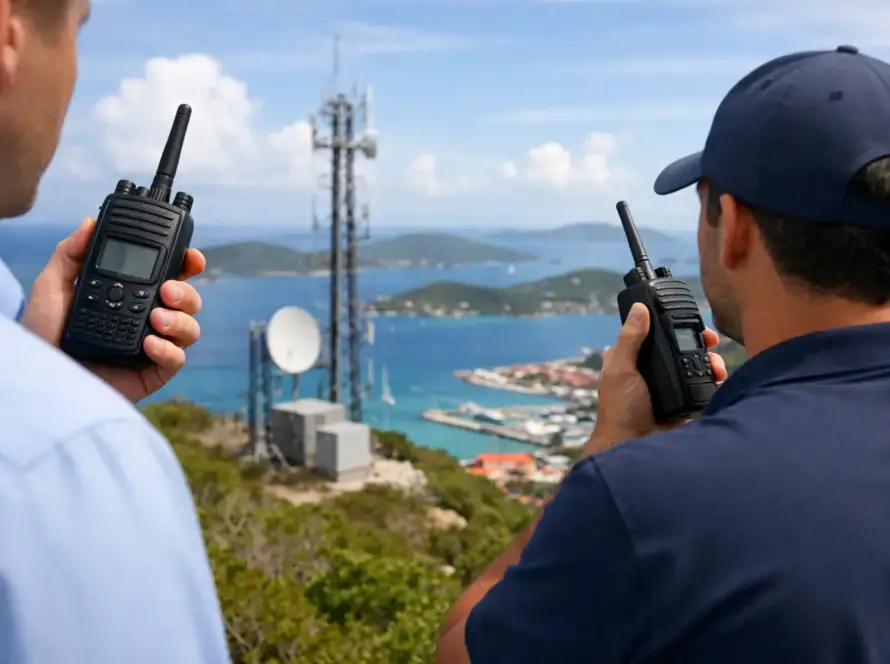
VHF generally performs best when antennas have a clear path between them. This makes antenna placement especially important. A properly located base station or repeater antenna can extend useful coverage significantly, while a handheld radio used behind a ridge or inside a reinforced building may have limited reach. For marine operations, antenna height can be a major advantage because open water often provides a clearer path than inland terrain.
Cellular service has its own variables. A phone may show signal bars but still deliver poor Push-to-Talk performance if the network is congested, data capacity is limited, or the device is moving between sites. Indoor coverage can also differ from outdoor coverage. A facility may need a distributed antenna system, signal enhancement strategy, Wi-Fi support, or a radio solution designed for the property rather than relying on public service alone.
This is why operational testing matters. Test radios and cellular devices in the areas where people actually work: loading zones, hillsides, docks, mechanical rooms, road routes, vessels, remote sites, and emergency assembly areas. The result is more valuable than a general statement that an area is “covered.”
Where VHF Has a Clear Operational Advantage
VHF is a practical choice when teams need instant, local voice communication without depending on commercial cellular infrastructure. A push of the button establishes a group call immediately, which is useful for marine crews, facility operations, transportation teams, security personnel, and field staff working within a defined area.
It also provides a valuable layer of resilience. If a cellular outage, power disruption, overloaded network, or damaged backhaul affects normal communications, radio systems can continue operating when they have been designed with appropriate power, antenna, and repeater support. Direct radio-to-radio communication can remain available even when a repeater is not reachable, although the operating range will be reduced.
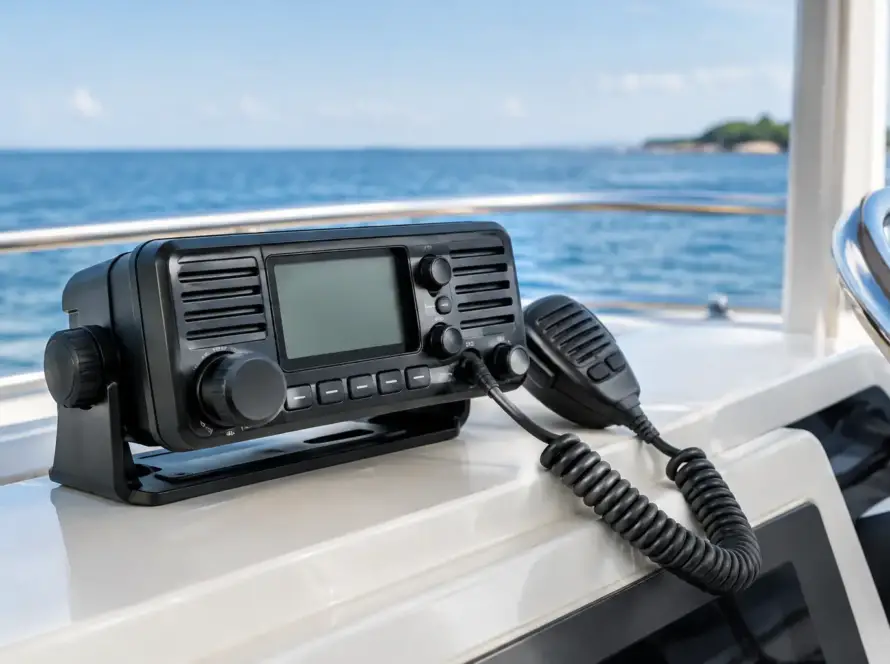
For maritime users, marine VHF remains essential for vessel-to-vessel, vessel-to-shore, and safety communications within the appropriate channels and regulations. It is not interchangeable with a business cellular application. Each serves a different purpose, and professional operations should preserve the communication methods required for safety and coordination.
VHF does have limits. It is usually not the best stand-alone option for connecting personnel across long distances, multiple islands, or a national workforce without a linked network infrastructure. It can also require licensing, frequency planning, equipment programming, and ongoing maintenance. Those are not drawbacks when the system is properly managed, but they should be part of the investment decision.
Where Cellular and PoC Deliver More Reach
Cellular-based Push-to-Talk over Cellular, often called PoC, turns a compatible radio-style device or application into a wide-area communications tool. If users have dependable cellular or Wi-Fi connectivity, they can communicate with a group across properties, islands, or distant locations without constructing a conventional radio repeater network for every area.
For a business with supervisors on Saint Croix, crews on Saint Thomas, and management off-island, that reach can be highly efficient. PoC can also support user management, talk groups, GPS location, messaging, and dispatch functions that are difficult to replicate with a basic conventional radio system.
The trade-off is dependency. A PoC device needs a functioning connection to the cellular network or Wi-Fi. If service is weak at a remote work area, inside a structure, or on a vessel outside usable carrier range, communication can be delayed or unavailable. The device itself may look and feel like a two-way radio, but its coverage model is fundamentally different.
Cellular can also introduce variable performance. Network priority, congestion, application configuration, data plan management, and device provisioning all affect the user experience. A business should verify that the platform, carrier options, and support plan fit its operating requirements rather than assuming any cellular device will perform the same way.
The Best Choice Is Often a Layered System
Many organizations do not need to choose VHF or cellular exclusively. They need a primary system for daily operations and a second path for coverage gaps, resilience, or expanded coordination.
A marina, for example, may use marine VHF for vessel operations and safety communications, VHF or DMR radios for dock and maintenance teams, and PoC for managers traveling between sites. A facilities organization may use on-site radios inside a large property while supervisors use PoC devices to stay connected across multiple locations. The system design should reflect each group’s mission, not force every user onto a single platform.
Interoperability deserves attention as well. Teams should know which device to use for routine coordination, emergency notifications, outside calls, and operations beyond the local radio footprint. Clear talk-group structure, channel naming, charging practices, user training, and documented procedures are just as important as the equipment itself.
Questions to Ask Before Selecting a Coverage Model
Start with the practical details. Are users generally within one facility, spread across several islands, moving by vehicle, working offshore, or entering areas with limited infrastructure? Do they need a simple group call, private conversations, GPS visibility, dispatch, text updates, or emergency alerts? How long can they tolerate a communications interruption?
Next, consider the conditions that are easy to overlook. Does the site have reliable power for fixed equipment? Are antennas permitted and safely installable? What happens during severe weather or a carrier outage? Are there locations where personnel work alone or cannot rely on a personal smartphone? These answers determine whether the system needs repeaters, backup power, external antennas, multiple carrier options, or direct-mode radio capability.
Finally, plan for ownership over time. Communications systems require programming, battery replacement, firmware management, repairs, coverage checks, and user support. Purchasing devices without a lifecycle plan can create coverage and reliability problems later, especially when operations expand.
Cwave Communications, an authorized Hytera dealer, helps organizations evaluate these operational requirements and build communications systems around real USVI conditions. The objective is not to sell more radios than necessary. It is to provide the coverage, support, and fallback capability the operation can depend on.
The strongest communications decision is usually made at the worksite: test the routes, identify the dead zones, define the critical conversations, and build the system around what your team must be able to do when conditions are less than ideal.