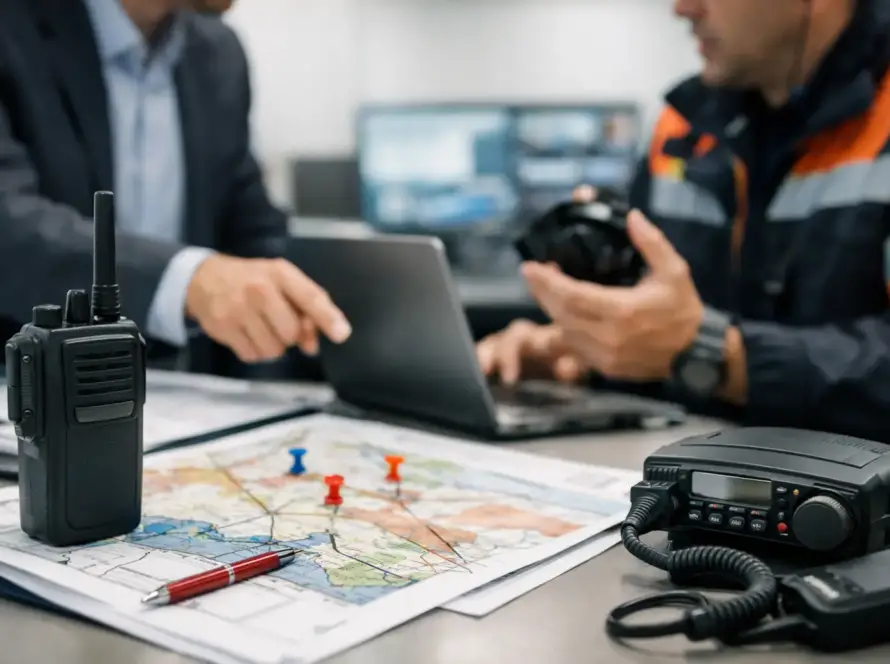
When a crew is spread between a waterfront facility, a vehicle fleet, a remote work area, and an office, a missed call can quickly become a safety, service, or scheduling problem. Reliable radio systems give teams a direct communications path that does not depend on every employee having cellular coverage, a charged smartphone, or the right app open at the right moment.
For organizations in the U.S. Virgin Islands, the requirement is more demanding than simply buying handheld radios. Hills, coastal exposure, reinforced buildings, inter-island travel, power conditions, and changing weather all affect performance. The right system is designed around how people work, where they need coverage, and what happens when normal communications are under pressure.
Why Radio Systems Still Matter for Daily Operations
Two-way radio remains one of the fastest ways to coordinate people. A single push of a button can reach a work group immediately, without dialing, waiting for a call to connect, or managing a long message thread. That speed matters for port activity, hospitality operations, maintenance teams, transportation, security, utilities, construction, and public-sector work.
The value is not limited to urgent incidents. Radios reduce routine friction: a supervisor can redirect a crew, dispatch can confirm an arrival, and a technician can request a part without leaving the work area. Clear communication supports better decisions because the people closest to the issue can exchange information in real time.
Purpose-built radio equipment also differs from consumer devices in practical ways. It can be selected for loud environments, extended shifts, rain exposure, glove use, or specialized accessories. A radio is an operational tool, not another device competing for attention with email, alerts, and personal applications.
That does not mean radios replace every other form of communication. Cellular, Wi-Fi, satellite services, and business applications each have a role. The best approach is to match the tool to the communication need, then make sure the systems work together where appropriate.
What a Dependable Radio System Requires
A dependable system begins with coverage, but coverage alone is not the whole answer. A radio may work well on an open dock yet struggle inside a concrete structure, behind a ridge, or across a large property. A professional assessment considers terrain, building materials, operating locations, vehicle routes, and the number of users who may need to talk at once.
Coverage built for the actual work area
Coverage should be measured against real workflows, not just a map radius around an antenna. Teams may need communications in stairwells, mechanical rooms, loading areas, parking structures, vessel berths, and remote road segments. Testing these locations before deployment helps avoid a system that looks sufficient on paper but leaves critical gaps in service.
For larger facilities or dispersed operations, repeaters, properly located antennas, and engineered signal paths may be needed. In some cases, a conventional local radio system is the right fit. In others, a networked solution or a combination of technologies provides better reach. The answer depends on the site, budget, desired capacity, and required level of redundancy.
Equipment matched to the environment
Not every radio needs the same features. A front-desk coordinator may need a compact, straightforward unit. A field technician may require a higher-capacity battery, a remote speaker microphone, and equipment rated for dust or moisture. A marine operator may have distinct channel, safety, and environmental requirements.
Standardizing too aggressively can create unnecessary cost, while mixing equipment without a plan makes training, charging, accessories, and repairs harder to manage. A well-designed fleet assigns the right radio and accessory package to each role while keeping daily use simple.
Clear talk groups and operating procedures
Even excellent equipment becomes less effective when everyone shares one crowded channel. Talk groups organize communications by function, location, or response need. For example, operations, maintenance, transport, and management may need separate day-to-day channels, with a designated channel for coordination when an incident affects multiple teams.
Channel plans should be easy to understand under pressure. Names, permissions, and escalation procedures should reflect how the organization actually operates. Training matters here. Employees need to know which channel to use, how to make a concise call, and what to do if they cannot reach their intended contact.
Choosing Between Analog, DMR, and Push-to-Talk Over Cellular
The right radio technology is a business decision as much as a technical one. It should support the operating model without adding complexity that the organization does not need.
Analog radio can be a practical option for small teams, limited coverage areas, or organizations maintaining an existing analog fleet. It is familiar, direct, and often cost-conscious. Its limitations become clearer when a business needs more users, greater channel efficiency, stronger audio control, user management, or advanced features.
Digital Mobile Radio, or DMR, is well suited to organizations that need improved capacity, audio performance, fleet management, and system scalability. Depending on the configuration, DMR can support features such as individual calling, emergency alerts, text messaging, GPS location, and controlled access. It is often a sound choice for fixed-site and local-area operations where dedicated radio infrastructure is part of the communications plan.
Push-to-Talk over Cellular, or PoC, extends radio-style communication over commercial cellular and Wi-Fi networks. It can connect teams across Saint Thomas, Saint John, Saint Croix, or farther afield when network coverage is available. PoC is especially useful for organizations with mobile workers, multiple sites, or personnel who need broad-area communication without building a conventional radio network at every location.
Each option has trade-offs. PoC depends on cellular or Wi-Fi availability, so it should not be treated as identical to a local RF system. A DMR deployment requires thoughtful infrastructure planning, particularly when wide-area coverage is required. Analog may be sufficient for a simple operation, but it offers fewer paths for growth. Many organizations benefit from a hybrid approach that keeps local radio coverage where it is essential and uses PoC for broader coordination.
Designing Radio Systems for Island Conditions
Island communications planning requires attention to conditions that may be less significant in a flat, densely connected market. Elevation changes can block or weaken signals. Salt air and moisture can shorten the life of poorly selected equipment and exposed connections. Hurricanes and power disruptions make backup power, equipment placement, and recovery planning operational priorities.
A proper design examines the full system: radios, antennas, repeaters, chargers, batteries, network connections, power protection, and maintenance access. It also accounts for the failure points that affect uptime. A repeater without backup power, a damaged antenna cable, or a depleted battery pool can limit communications just when teams need them most.
This is where local technical knowledge adds value. Cwave Communications, an authorized Hytera Dealer, helps organizations assess coverage requirements, select appropriate equipment, and support the system after installation. The objective is not to sell features for their own sake. It is to deliver communications that fit the site, the workforce, and the mission.
Maintenance Is Part of System Reliability
A radio system is not a one-time purchase. Batteries age, antennas need inspection, firmware may need updating, user assignments change, and accessories wear out. Organizations that plan for lifecycle support are better positioned to avoid avoidable failures and unexpected replacement costs.
Routine maintenance should include battery health checks, charger inspections, audio testing, antenna and cable reviews, programming verification, and an inventory of spare equipment. For larger fleets, maintaining clear records of serial numbers, assigned users, accessories, and repair history makes support faster and budget planning more accurate.
It also helps to review the system after operational changes. A new building, expanded service territory, additional vehicles, or a larger staff can alter coverage and capacity requirements. Communications should be reviewed as the organization grows, not only after a problem appears.
A Better Starting Point Than Buying Radios
Before selecting models or requesting pricing, define the operational requirement. Identify who needs to communicate, where they work, how many conversations may occur at once, and which locations cannot tolerate a coverage gap. Consider whether teams need local-only communication, inter-island reach, location awareness, emergency features, or integration with existing networks.
The result should be a communications plan with clear priorities: coverage, reliability, usability, security, growth, and serviceability. The most effective radio systems are the ones employees trust enough to use without hesitation – shift after shift, in normal operations and when conditions become difficult.