A missed call between a vessel and shore is rarely just an inconvenience. It can delay a charter departure, leave a crew without updated weather information, slow a maintenance response, or create confusion during an emergency. St John marine communications should be designed around those real operating moments, not around a radio purchase alone.
For operators working the waters around Saint John, reliability comes from the full communications system: the right radios, correctly installed antennas, dependable power, practical operating procedures, and support when equipment needs attention. Conditions change quickly between open water, protected bays, dock areas, and elevated island terrain. A system that performs well at the dock may not provide the same results on a working route.
What St John Marine Communications Must Handle
Marine communications serve several jobs at once. A captain may need to monitor safety traffic, coordinate a pickup with shore personnel, contact another vessel, receive operational changes, and call for assistance if conditions deteriorate. Each use case has different coverage, channel, and equipment requirements.
For many vessels, fixed-mount VHF remains the primary foundation for marine safety and vessel-to-vessel contact. It is purpose-built for the marine environment and, when paired with a properly selected and installed antenna, generally provides better transmit performance than a handheld radio. Digital Selective Calling, or DSC, can add another layer of capability when the radio is properly configured with the vessel’s assigned identity information.
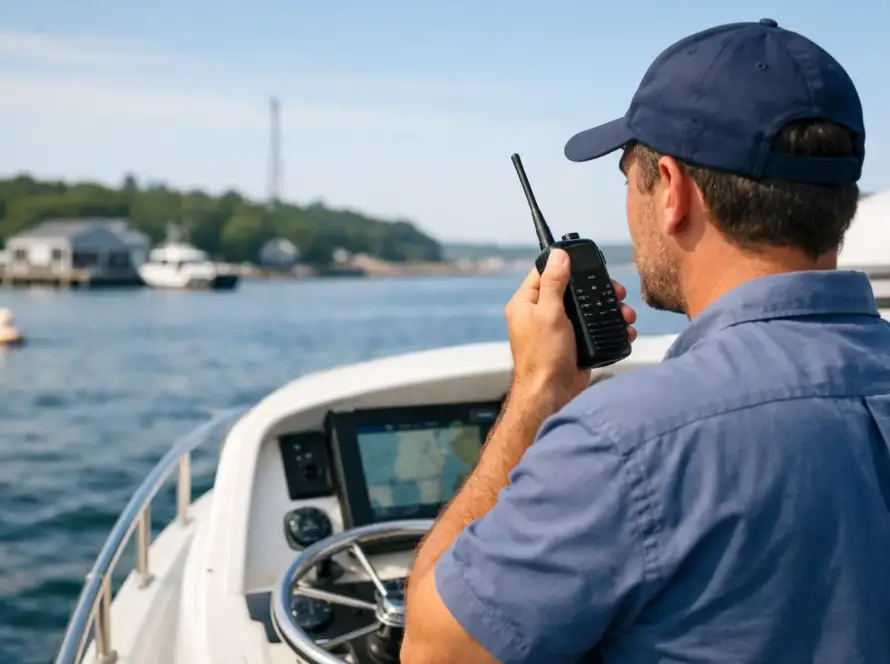
Handheld marine radios still have a clear role. They provide mobility on deck, a backup if the vessel loses primary power, and a practical option for smaller boats. Their limitations matter, though. Lower antenna height, battery condition, water exposure, and physical obstructions can reduce usable range. A handheld should support the primary plan, not carry responsibilities beyond its design.
For shore teams, marinas, fleet managers, and maintenance personnel, marine VHF may be only part of the picture. Two-way business radio or Push-to-Talk over Cellular can give land-based personnel a separate communications path for dispatch, work coordination, and escalation. Keeping marine safety traffic distinct from routine business traffic helps crews stay clear and focused when it matters.
Coverage Is More Than a Range Number
Radio range is often discussed as a single number, but actual performance depends on line of sight, antenna height, antenna quality, installation details, transmit power, weather, vessel position, and surrounding terrain. The hills and coastline around Saint John can create areas where a signal that was clear minutes earlier becomes weak or blocked.
That is why an operational coverage review is more useful than a generic range claim. Start with the routes a vessel actually runs. Consider common departure points, charter locations, inter-island travel, anchorages, service areas, and areas where crews have reported communication problems. A system should be evaluated where the work happens, not only from a showroom or dockside test.
Antenna placement deserves special attention. Marine antennas need adequate height and a clear path as practical, but they also need secure mounting, appropriate coaxial cable, protected connections, and consideration for the vessel’s movement and structure. A high-quality radio connected to a poor antenna system will not deliver the reliability operators expect.
Shore-based coverage has its own variables. Buildings, docks, hillsides, reinforced structures, and generator noise can affect radio performance. In some operations, the answer may be a fixed base radio, an external antenna, a cellular-based group communications platform, or a combination of these tools. The right choice depends on whether the priority is offshore contact, dock coordination, island-wide workforce communications, or all three.
Build the System Around Your Operation
A charter company, marina, construction supplier, dive operator, passenger vessel, and government department do not communicate in the same way. Selecting equipment before defining operating requirements can leave costly gaps.
Begin with the people who must communicate. Identify who is on the vessel, who is shore-side, who supervises operations, and who needs to be reached after hours. Then establish the calls that must get through: routine check-ins, departure and arrival updates, maintenance coordination, passenger support, weather changes, and emergency escalation.
It also helps to decide which communications should remain on marine channels and which should move to a dedicated business platform. Marine VHF channels are shared working and safety resources. They are not a replacement for private team communications. A separate business radio or PoC group can reduce unnecessary traffic while giving supervisors better control of call groups and communications records where appropriate.
For organizations with personnel spread between Saint John, Saint Thomas, and Saint Croix, a mixed environment is common. Vessel crews may require VHF at sea, while dispatchers and managers need communications that follow them through offices, vehicles, docks, and job sites. A well-designed system recognizes those different environments instead of forcing one device to solve every problem.
Installation and Maintenance Determine Reliability
Marine electronics work in heat, humidity, vibration, salt air, and frequent washdown exposure. Even quality equipment can become unreliable when connectors corrode, cables are damaged, antennas loosen, or power connections degrade.
A professional installation should account for equipment location, access for service, cable routing, circuit protection, grounding requirements where applicable, waterproofing, and antenna separation. The radio must also be positioned where the operator can use it quickly without distracting from safe vessel operation.
Maintenance should be scheduled rather than postponed until a radio fails. Periodic inspections can identify corroded connections, aging batteries, damaged microphones, weak audio, and antenna issues before they become operational problems. Testing transmit and receive performance, reviewing programmed settings, and confirming emergency features are functioning should be part of a practical service plan.
For handheld equipment, battery management is especially important. Crews should know which batteries are fully charged, how to store spare batteries, and when a battery has reached the point where replacement is the safer choice. A radio that powers on is not necessarily ready for a full shift.
Cwave Communications, an authorized Hytera Dealer, supports organizations that need communications planned as an operational system, with local service capability for equipment, network design, repair, maintenance, and long-term lifecycle support.
Clear Procedures Make Good Equipment More Useful
The strongest radio system can still fail operationally when users are uncertain about channels, call signs, priority traffic, or escalation steps. Short, repeatable procedures make a measurable difference.
Every crew should know the primary calling method, the backup method, and the action to take when a shore contact does not respond. Supervisors should establish who has authority to move routine traffic to another channel or platform, when a missed check-in requires follow-up, and how emergency communications are handled. These procedures do not need to be complicated. They need to be understood and practiced.
Training should include basic radio discipline: listen before transmitting, keep messages concise, state the intended recipient first, confirm critical details, and avoid tying up shared marine channels with routine conversation. Operators should also be comfortable using the equipment’s safety features rather than trying to learn them under pressure.
A useful field test is to ask a new crew member to complete a typical call during normal operations. If the correct radio, channel, and procedure are not obvious, the system needs clearer labeling, training, or configuration.
Plan for Redundancy Without Adding Confusion
Redundancy is valuable in maritime operations, but more devices do not automatically mean better preparedness. A backup plan must be simple enough for crews to use correctly.
A common approach is a fixed-mount marine VHF as the primary vessel radio, a charged handheld as a backup, and a separate cellular or business radio path for operational coordination when coverage is available. The exact combination depends on vessel size, routes, passenger count, staffing, and regulatory requirements.
Power is part of redundancy as well. If the main electrical system is unavailable, crews need to know what communications equipment remains usable and for how long. Backup batteries, charging procedures, and storage locations should be documented and checked. For shore facilities, consider how communications continue during utility interruptions or network outages.
The goal is not to create a complicated stack of radios. It is to ensure that a single point of failure does not leave the crew or shore team without a workable way to communicate.
A Better Standard for Marine Readiness
St John marine communications are most effective when they reflect the realities of island operations: changing weather, uneven terrain, saltwater exposure, busy docks, distributed teams, and the need to make decisions quickly. Equipment matters, but installation quality, coverage planning, maintenance, and operator readiness matter just as much.
Before the next busy season or vessel expansion, review where communications have been weak, delayed, or unclear. The most valuable improvement may be a better antenna, a tested backup radio, a dedicated shore-side channel, or a clearer check-in procedure. Reliable contact starts with a system built for the work your team performs every day.