A fleet communication system usually gets tested at the worst possible moment – a reroute, a missed delivery window, a vehicle issue, or a driver trying to reach dispatch from an area with uneven coverage. That is where push to talk over cellular for fleets starts to make sense. It gives drivers and supervisors the speed of radio-style communication while using cellular networks, which can be a practical fit for businesses that need broad coverage, simpler scaling, and less dependence on a single local radio footprint.
For fleet operators, the appeal is straightforward. People do not want to place a phone call every time they need to update a route, report a delay, or ask for instructions. They want one-button communication that feels immediate. Push-to-talk systems are built for exactly that, but over cellular changes the deployment model in ways that matter for growing organizations.
What push to talk over cellular for fleets actually does
Push to talk over cellular, often called PoC, combines the familiar talk-group behavior of two-way radio with the reach of commercial cellular data networks. A driver presses a button, speaks, and the message goes to an individual, a workgroup, or a larger fleet channel almost instantly.
That sounds simple, but the business value is in how it changes day-to-day coordination. Dispatch can reach multiple drivers at once without starting a chain of separate calls. Supervisors can create groups by route, department, shift, or service area. Managers can add users without building out a full radio network for every change in operations.
For many fleets, that flexibility is the difference between a communication tool people tolerate and one they actually use.
Why fleets are moving beyond phone calls and basic radio
Phone calls work for one-to-one communication, but they do not scale well in an active fleet. If a dispatcher has to contact six drivers about a weather delay, six calls take time and create room for inconsistency. A single push-to-talk message is faster and keeps everyone on the same page.
Traditional radio still has clear strengths, especially where private coverage, local control, or off-network resilience is critical. But it also comes with planning requirements. Coverage areas, repeaters, licensing, capacity, and system maintenance all have to be considered. For some organizations, that is the right investment. For others, especially fleets that need quick deployment across varied operating areas, PoC may be the more efficient option.
This is not really a question of old versus new. It is about matching the communication method to the operating model.
Where PoC fits best in fleet operations
Push to talk over cellular for fleets tends to work well when teams are mobile, spread out, and changing often. Delivery fleets, service vehicles, utility support teams, marine support vehicles, facilities operations, and transportation contractors often need voice communication that is immediate but not tied to a limited radio footprint.
It is also useful when a fleet crosses multiple coverage environments during the day. A team may start at a warehouse, move between customer sites, support field work, and coordinate with office staff who are not carrying traditional radios. PoC can bring those users into the same communication flow through dedicated devices, mobile handsets, or dispatch consoles, depending on the system design.
That matters in the U.S. Virgin Islands, where terrain, distance, and day-to-day operating patterns can affect how well a single communication method serves every team. A practical solution often starts with the question, where are your people actually working, and what happens when plans change quickly?
The real advantages for fleet managers
The biggest advantage is speed without complexity. Drivers do not need to scroll through contacts, start calls, and repeat the same message several times. They push a button and communicate in the moment.
The second advantage is scalability. Adding a new vehicle or supervisor to a PoC environment is usually simpler than expanding a conventional radio system. For organizations dealing with seasonal growth, contractor support, or changing routes, that can reduce both delays and administrative friction.
There is also a cost and maintenance angle. Because PoC uses existing cellular infrastructure, businesses may avoid some of the capital expense associated with building and maintaining wide-area radio coverage for every operating zone. That does not mean PoC is always cheaper in every scenario. Recurring service plans, device management, and data dependency still need to be evaluated. But for many fleets, the total operational model is easier to manage.
Another benefit is visibility and control. Many modern PoC platforms include dispatch applications, GPS location awareness, group management, recording options, and administrative tools. That can help supervisors manage field activity with more context than voice alone.
The trade-offs decision-makers should consider
PoC is not magic, and it is not the right fit for every fleet.
Its biggest dependency is the availability and quality of cellular data coverage. If your vehicles regularly operate in dead zones, inside hardened structures, or in areas where network performance fluctuates heavily, that has to be accounted for before deployment. A system that sounds good in a demo but fails in the field will not earn user trust.
Latency is another factor. Good PoC systems are fast, but they do not behave exactly like every traditional land mobile radio environment. For routine dispatch and coordination, that may be perfectly acceptable. For highly time-sensitive workflows, the difference should be tested, not assumed.
Battery management, device selection, and user habits also matter. A purpose-built PoC radio can be a better fleet tool than relying only on consumer smartphones, especially when drivers need loud audio, simple controls, and equipment that holds up in demanding conditions.
Security and administration deserve attention as well. Organizations should know how users are authenticated, how groups are managed, what happens when devices are lost, and how the platform aligns with internal IT and operational policies.
Choosing the right setup for your fleet
A good PoC deployment starts with workflow, not hardware. Before selecting devices or service plans, it helps to map how communication actually happens during a normal shift and during a disrupted one.
Who needs to talk to whom? Are communications mostly one-to-many from dispatch, or do drivers frequently coordinate with one another? Do supervisors need live visibility of multiple teams? Will office staff, field crews, and vehicle operators all be on the same system?
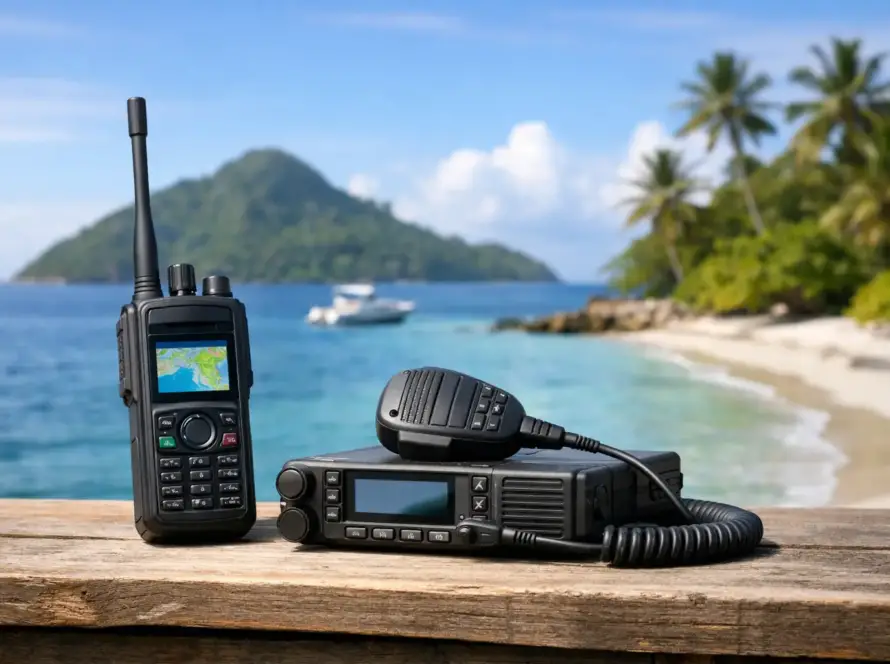
From there, device strategy becomes clearer. Some fleets benefit from in-vehicle mobile units with external antennas and stronger audio. Others need handheld devices that move with the worker. Some require a mix of both, plus a desktop dispatch console for management staff.
Coverage testing is just as important as feature review. For island operations, local knowledge matters. A communication plan that looks fine on a map may behave differently around ports, hills, dense structures, or remote work areas. That is one reason businesses often benefit from working with a provider that understands regional operating conditions rather than simply shipping devices and leaving the rest to the customer.
PoC, radio, or a hybrid approach?
In many cases, the best answer is not either-or. It is a hybrid.
Some fleets need the flexibility of PoC for wide-area coordination and the reliability of traditional radio for specific sites, operational zones, or continuity planning. A mixed environment can support office-to-field communication, vehicle dispatch, and local team coordination without forcing every user into the same tool for every task.
That kind of planning takes a little more thought up front, but it usually produces a system that reflects real operations instead of a sales brochure. Cwave Communications approaches these projects from that practical angle – what coverage is needed, how teams work, what support is required, and what will still perform well after the rollout is no longer new.
What successful adoption looks like
The best fleet communication systems are not the ones with the longest feature list. They are the ones people trust under pressure.
That means audio has to be clear. Group structure has to be logical. Devices have to be easy to use without training turning into an ongoing problem. Supervisors need control without creating confusion, and drivers need communication tools that help them do the job rather than distract from it.
If push to talk over cellular for fleets is being considered, the right question is not just whether it works. The better question is whether it fits the way your fleet actually moves, communicates, and responds when conditions change.
That is where good communication planning pays off. The right system should reduce friction, improve response time, and give your team more confidence on the road – especially on the days when operations do not go according to plan.