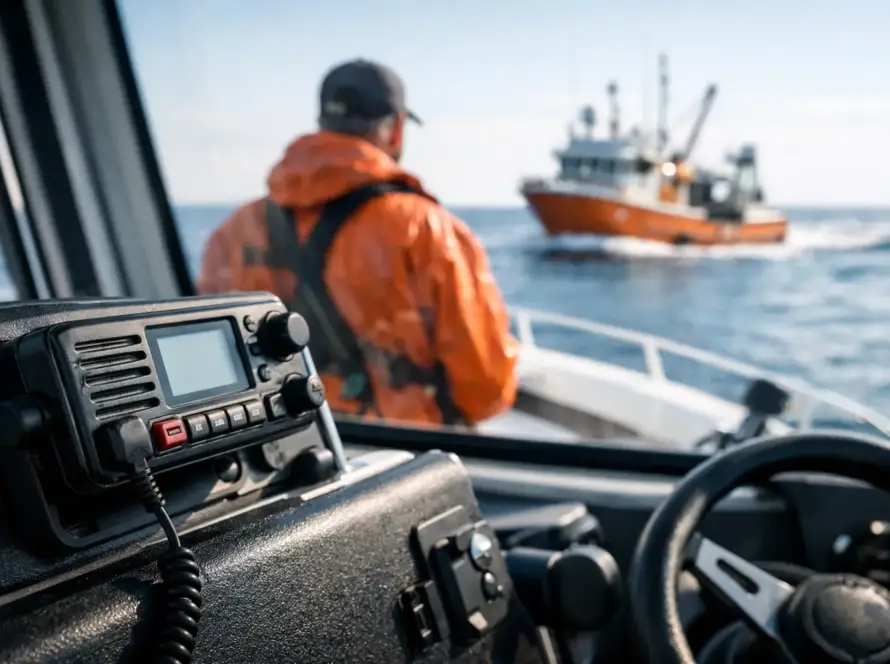
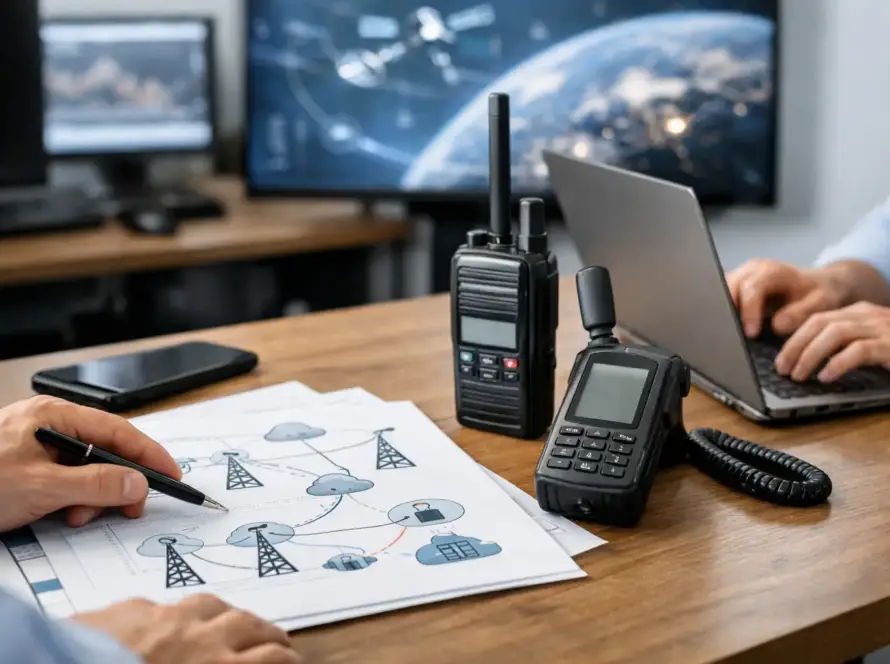
A missed radio call can delay a vessel turnaround, leave a field crew waiting for instructions, or create confusion during an outage. That is why the Hytera PoC vs DMR decision should start with the way your people actually work, not with a preference for the newest device. Both platforms support professional push-to-talk communications, but they use very different infrastructure and solve different operational problems.
For organizations in the U.S. Virgin Islands, the distinction matters. Island terrain, building density, marine routes, weather exposure, and uneven cellular conditions can all affect communications performance. The right answer may be PoC, DMR, or a planned combination of both.
Hytera PoC vs DMR: The Core Difference
Hytera Push-to-Talk over Cellular, commonly called PoC, sends voice communications through cellular data networks and Wi-Fi. A user can press the push-to-talk button on a PoC radio or compatible smart device and communicate with an individual, group, or dispatch center wherever a suitable data connection is available. The practical advantage is reach: a team on Saint Croix can coordinate with supervisors on Saint Thomas, a driver off-island, or a remote office without building a dedicated radio network between them.
Digital Mobile Radio, or DMR, uses licensed radio frequency spectrum. Radios communicate directly with one another within range, or through repeaters that extend coverage across a property, facility, road corridor, harbor, or wider service area. A properly engineered DMR system is owned and controlled by the organization or its designated system operator. It does not require public cellular service for routine radio-to-radio communications within the designed coverage footprint.
That difference drives almost every other consideration. PoC depends on available broadband connectivity. DMR depends on radio coverage design, suitable spectrum licensing, equipment placement, power resilience, and ongoing maintenance.
When Hytera PoC Makes Operational Sense
PoC is often the practical choice for organizations whose teams travel beyond a single radio coverage area. Delivery operations, property management groups, service companies, dispersed administrative teams, and multi-island supervisors can benefit from wide-area push-to-talk without waiting for a dedicated repeater network to be installed.
The service can also simplify communications for organizations that already rely on cellular-connected work devices. Users can be organized into groups by department, shift, location, or function. A manager may speak to the entire operations team, contact one technician privately, or create a temporary group for a specific assignment. Depending on the platform and service configuration, dispatchers may also have location awareness, messaging, call history, and emergency alert functions.
PoC deployment is generally faster than a conventional radio network because it does not begin with tower studies, repeater sites, antennas, feedline, and RF coverage testing. That does not mean it is automatic. Devices must be provisioned correctly, user groups must reflect the organization’s real workflow, cellular plans must be appropriate for the expected use, and staff need clear operating procedures.
PoC has a meaningful limitation: coverage follows the available cellular or Wi-Fi connection. In a building with poor indoor signal, on a remote worksite, along a marine route, or during a wider carrier disruption, a PoC device may not provide the communications path your operation needs. Organizations should verify real-world coverage in the places where people work, not just review a carrier coverage map.
Where DMR Has the Advantage
DMR is built for controlled local and regional radio communications. It is a strong fit when teams need immediate push-to-talk performance in a defined operational area and cannot accept dependence on commercial cellular service. Examples include facilities, ports, resorts, utility sites, construction projects, warehouses, event venues, and marine operations operating within a planned coverage zone.
A DMR system can be designed around the actual environment. Radio coverage inside a concrete building requires a different approach than coverage across hilly terrain, a waterfront compound, or a fleet operating around a harbor. Repeaters, antenna locations, power protection, and in-building solutions can be selected to address those conditions rather than relying on public-network availability.
DMR also provides predictable talkgroup structure and direct operational control. With the right system design, teams can separate routine operations, maintenance, security, dispatch, and emergency traffic. Radios can support features such as individual calling, text messaging, emergency buttons, GPS, and encryption where permitted, supported, and properly managed. The specific feature set depends on the selected Hytera radios, system architecture, licensing, and policy.
The trade-off is infrastructure responsibility. A DMR system requires planning, licensed spectrum coordination, installation, testing, and lifecycle support. Repeaters and antennas need reliable power, inspection, storm preparation, and repair capability. Those investments can be worthwhile when communications availability is central to safety, production, or continuity, but they should be evaluated as a long-term operational asset rather than a one-time equipment purchase.
A Practical Comparison of PoC and DMR
| Operational factor | Hytera PoC | Hytera DMR | | — | — | — | | Primary coverage source | Cellular data and Wi-Fi | Licensed RF channels, direct radio paths, and repeaters | | Best fit | Distributed teams and wide-area coordination | Defined sites, local operations, and controlled coverage | | Infrastructure requirement | Device provisioning and data service | Radio design, licensing, repeaters, antennas, and power | | Performance during cellular outage | Limited where no alternate data path exists | Can continue within designed RF coverage | | Geographic reach | Potentially broad, including off-island users | Limited to direct and repeater coverage footprint | | Ongoing cost pattern | Recurring data and platform service costs | Infrastructure maintenance, licensing, and support costs |
The table is useful, but it should not be treated as a simple scorecard. A company with staff across multiple islands may need PoC for management and dispatch, while its waterfront facility or critical worksite requires DMR for dependable local operations. The communications question is rarely whether one technology is universally better. It is whether the technology supports the failure conditions your organization must plan for.
Coverage and Resilience in the USVI
Communications planning in Saint Thomas, Saint John, and Saint Croix should account for more than normal-day coverage. Hills, valleys, reinforced structures, coastal exposure, and power interruptions can change what users experience in the field. A radio that works well near an office may perform very differently at a dock, a remote utility location, or the far side of a large property.
For PoC, test devices with the intended carrier service in the actual operating zones. Confirm indoor performance, travel routes, waterfront areas, and any locations where teams may be assigned after hours. Consider Wi-Fi as a useful supplement indoors, but do not assume it replaces a resilient communications plan unless its power, network, and backhaul are protected.
For DMR, a coverage assessment should establish the required talk-in and talk-out performance before equipment is installed. Repeater location, antenna elevation, cable losses, backup power, and site access all affect the final result. A system that looks sufficient on paper can disappoint users if it is not designed and field-tested for the terrain and buildings involved.
Resilience also involves people. Establish clear radio discipline, emergency procedures, spare-device availability, battery charging practices, and escalation paths when a user cannot be reached. Technology supports operations best when the operating plan is just as disciplined as the equipment.
Cost Should Be Measured Over the System Life
PoC often has a lower initial infrastructure cost. Organizations can purchase devices, activate service, configure user groups, and begin operating quickly. The ongoing expense is typically tied to cellular connectivity, platform access, device replacement, and support. For a team that needs broad geographic reach but does not require dedicated RF coverage, that model can be efficient.
DMR commonly requires a larger upfront investment because coverage is engineered and installed. Costs may include licensing, radios, repeaters, antennas, site work, power systems, and maintenance. Yet over time, a well-supported DMR system can deliver substantial value where it reduces downtime, improves coordination, and maintains local communications independent of cellular availability.
Do not compare only handset prices. Compare the cost of a missed call, a delayed response, a service interruption, or a crew operating without communications. Then consider support, repairs, replacement planning, software administration, and the expected life of the system.
Choosing the Right Hytera Communications Plan
Start by mapping your operational reality. Identify where users work, whether they remain on one site or move between islands, how many simultaneous groups need to communicate, and what must happen if cellular service or commercial power is unavailable. Separate routine convenience from mission-critical requirements. A supervisor who needs to reach a traveling team has a different need from a crew that must coordinate inside a coverage-critical facility.
Next, decide which communications functions require local control and which benefit from wide-area access. This often reveals that a hybrid design is the right choice. DMR can serve a facility, port, worksite, or local fleet area, while PoC extends coordination to managers, remote staff, and users outside the RF footprint. Procedures can define which platform is primary for each task so users are not left guessing during a disruption.
Cwave Communications, an authorized Hytera dealer, can help organizations assess field conditions, select appropriate devices, design coverage, and support the system after deployment. The goal is not to add technology for its own sake. It is to build a communications plan that remains useful when schedules tighten, weather changes, and operations cannot wait.
The best next step is a coverage and workflow review with the people who use the radios every day. Their dead spots, call patterns, and response requirements will point to the system your operation can rely on when it matters.